Merlin's Liminal Tension, Sweeney's Wild Exile
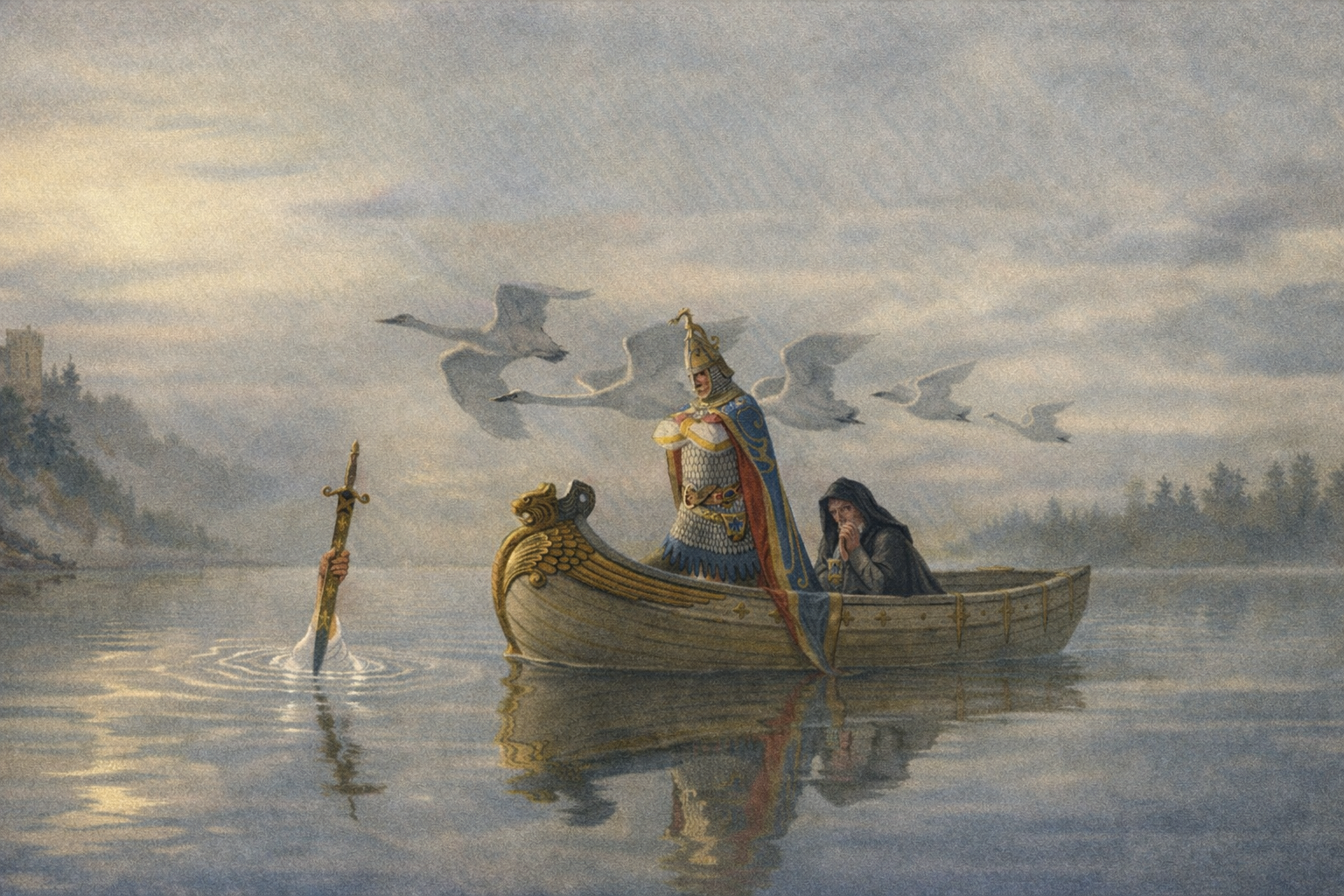
Enchantment, captivity, and the disciplines that keep us human — Merlin and Suibhne as liminal figures who become voices of warning and vision.
I. The Age of Enchantment
We live inside a dream we did not choose.
Scroll through any screen for twenty minutes and you will find yourself somewhere else entirely — entertained, outraged, momentarily certain, then empty. The content is inexhaustible. The attention it demands is total. The self that emerges from the other side is subtly less itself than the one that went in.
The medieval imagination had a name for this. It called it enchantment.
Not the gentle variety of fairy tales — not wands and wishes — but the dangerous kind: the beautiful sealed world that captures attention, dissolves responsibility, and replaces lived memory with a dream more vivid than waking. Morgan le Fay trapping knights in pleasure-domes they cannot bring themselves to leave. The fairy mound where time stops and the visitor returns to find everyone they knew is dead. Coleridge’s Xanadu, where the man wakes from his vision and finds he cannot finish the poem — the enchantment was the content, and the content was the trap.
These stories do not feel like antiquarian curiosities. They feel like warnings addressed to us specifically, about something we have only recently managed to build at industrial scale.
Two figures stand at the edge of these warnings — one from the Arthurian tradition of Wales and France, one from the medieval Irish of Ulster. Merlin. Suibhne Geilt. Each pushed to the boundary of time, society, and self. Each made a voice of warning and vision precisely because they could not remain inside the dream.
II. Merlin: Knowledge Split by Time
To understand Merlin’s liminality, you have to begin with a story that most modern tellings leave out entirely — a story preserved in the Lancelot-Grail cycle, the great prose compilation of thirteenth-century France, sometimes called the Vulgate Cycle.
Before there was a Merlin, there was a plan.
The demons of hell, the text tells us, sought to produce an Antichrist — a being who would carry their nature into the world and undo what Christ had done. They chose a woman of exceptional virtue for the violation that would conceive this creature, calculating that corruption of the holy is more powerful than corruption of the already-fallen. But they miscalculated. The woman was a Christian. She confessed immediately. She prayed. Her virtue held.
The child was born with the devil’s gifts: total knowledge of the past, all of human history written on his memory before he drew his first breath. But because of the mother’s faithfulness, God intervened. The prophetic gift was added to the retrospective one — knowledge of the future granted as counterweight, as honor to the mother’s prayer, as instrument of divine purpose. The intended Antichrist became a prophet in the service of a king.
This is Merlin’s origin. Not a magician who learned his craft. Not a wise man born with unusual gifts. A figure whose very existence is a theological argument — the corruption redeemed, the demonic intention turned inside out, the enemy’s weapon used against him.
What this origin produces is a consciousness split by time. Merlin possesses the past completely, the way memory works when nothing has been lost. He possesses the future the way prophecy works when it is genuinely given — not as prediction but as a kind of already-witnessing, the future seen the way we see what has already happened. He is denied only the present. The present is where he is liminally suspended, unable to fully inhabit it, speaking from both directions toward a center he can see but not occupy.
This is the source of his strangeness and his danger. He tells Arthur the truth in riddles not because he enjoys the game, but because the future he sees cannot be stated plainly without collapsing it. Prophecy is not prediction. It is moral perception — the ability to see the consequences that are already latent in present choices, the patterns that will manifest unless something changes. Every prophecy Merlin makes is a demonstration of the original act of grace: the enemy’s gift turned to God’s purpose.
The liminality cuts both ways. Merlin is never fully trusted because his origins are never fully clean. The demon blood is real. He lives at the edge of the court, consulted but not embraced, necessary but unsettling. His eventual imprisonment — whether at Nimue’s hands in the hawthorn tree, or in the cave of Broceliande, or in the glass tower — is the final expression of what was always true: Merlin is the figure who exists at the threshold. The inside is not where he was made to live.
III. Suibhne: The King Becomes the Wild Man
Seven centuries before the Vulgate cycle was compiled in France, a battle was fought at Mag Rath in Ulster. The year was approximately 637. A king named Suibhne Geilt rode into that battle and came out of it changed.
The change was a curse. Saint Ronan Finn, whose psalter Suibhne had flung into the lake in fury, whose clerk Suibhne had killed when the priest attempted to stop the march to war — Ronan cursed him. The madness that took Suibhne was not gradual. It descended at the noise of the battle itself: the clash of arms, the screaming of men and horses, the exact intensity that Suibhne’s violence had helped create, turned back against his own mind.
He flew. That is what the text says. He sprouted feathers — not physically, or not only physically — and left the field of battle in flight. He spent the remainder of his life in the trees and bogs of Ireland, sleeping in yew trees, drinking from streams, fearing human contact, moving from place to place as exile and prophet. He composed poetry of extraordinary beauty.
The Buile Suibhne — the Frenzy of Sweeney — is a text that knows what it is doing. Suibhne’s madness is not presented as mere punishment. It is a doorway. What he loses — kingship, sanity, place in society, the comforts of table and bed and fire — he trades for something he could not have acquired otherwise: a perception of the natural world so exact that it becomes lyrical, a moral vision so stripped of political necessity that it can name things courts cannot afford to name.
The tragedy is that this vision requires exile. It cannot be brought inside. Every time Suibhne approaches civilization — his wife, his former kingdom, a house with a fire — the madness intensifies, the wings return, and he flees. He is not refusing civilization. He is constitutionally unable to inhabit it after what happened to him.
What happened to him was violence encountering holiness and producing a third thing: the holy madman, the truth-speaker who lives in the margins because the center cannot hold him.
IV. Prophecy Is Not Prediction
Both figures are called prophets. Neither is a fortune-teller.
Prophecy, in the medieval imagination, is not primarily about the future. It is about seeing clearly in the present. The prophet perceives the moral weight of what is happening — the spiritual physics of a situation, what it is becoming, what its trajectory makes inevitable. Merlin does not tell Arthur what will happen because he has consulted a calendar. He tells Arthur what will happen because he can see what Arthur is choosing, and he knows what choices of that kind produce.
Suibhne’s poetry works the same way. His laments for the life he lost, his precise observations of birds and rivers and weather, his ongoing argument with God about whether exile is punishment or gift — none of this is prediction. It is attention so focused, so stripped of self-protection, that it perceives things the sane and settled cannot afford to notice.
Both figures are uncomfortable. That is the point. The value of the liminal voice is not that it brings comfort but that it brings accuracy. The court needs Merlin not because he makes the future safe but because he makes it navigable. The Irish tradition preserves Suibhne’s words not because they are reassuring but because they are true.
V. Is Merlin Trapped — Or Is Time the Trap?
Merlin’s imprisonment is usually read as tragedy — the wise counselor neutralized, the prophecy silenced, the Round Table left without its guide. But there is another reading.
Merlin’s liminality was never sustainable. A being who exists at the threshold between past and future, between demonic origin and divine purpose, between human court and inhuman perception — such a being cannot be permanently absorbed into the structures of the world. The court always tries. It always fails. The imprisonment is not the end of Merlin’s story. It is the story finally becoming its own form.
Coleridge’s poet in “Kubla Khan” wakes from his vision unable to finish the poem. The vision was real; the capacity to hold it in waking life was not. Merlin’s cave is the same paradox resolved differently. He is held inside the vision now, not outside it. The imprisonment that looks like defeat from the court’s perspective looks, from another angle, like a return to his proper element.
This is not a comfortable reading. It does not rescue Merlin for ordinary use. But it asks an important question: what does it cost to maintain the liminal voice in a world that continually tries to domesticate it?
The answer, in both traditions, is everything. Merlin loses the world. Suibhne loses it too. What they keep is the perception that made the world worth losing.
VI. St. Moling and the Salvation of Listening
The Buile Suibhne would not exist without Saint Moling.
Near the end of the text, Suibhne arrives at the monastery of Saint Moling in Leinster. Moling is the one who writes the poems down. He is the one who listens — not just passively, but with the active, structured attention of the monastic tradition, the lectio divina sensibility that treats the act of hearing as a sacred discipline. He does not edit Suibhne. He records him. He creates the conditions under which Suibhne’s truth-speaking can survive the man who spoke it.
The same monastic principle is at work in the transmission of Arthurian legend. The Vulgate Cycle — the compilation that preserves Merlin’s origin story, the Grail quest, the tragedy of the Round Table — reached us through monasteries. The monks who copied these texts were not neutral archivists. They read them through a spiritually interpretive lens. They preserved them because they understood that the stories contained something that warranted preservation: a moral grammar, a way of seeing human failure and redemption, a tradition of how enchantment differs from grace.
This is not coincidence. The monastic tradition understood that memory requires structure, that truth-speaking requires a listener, that the liminal voice requires someone willing to stand at the threshold with it and write down what it says.
The discipline of listening — of Moling writing, of monks copying, of readers attending — is the practice that allows the prophetic voice to outlast the prophet. It is also, not incidentally, the discipline most directly threatened by the age of enchantment. When attention is perpetually captured and perpetually released, when no piece of content merits sustained engagement, the Moling function disappears. No one is writing it down. No one is listening long enough to hear what is actually being said.
VII. What the Past Asks of Us Now
Medieval monks rose at two in the morning to pray. They copied manuscripts by hand. They tended gardens and kept bees and maintained the books and said the offices and died in their cells. These are not practices we can import wholesale, and the tradition would not ask us to.
But the practices point toward something recoverable: the discipline of attention. Reading slowly. Writing carefully. Making things by hand — code, bread, music, prose — with the patience that allows genuine craft to develop. Praying or meditating in the way that acknowledges there is something worth attending to that is not on a screen. Sitting with a difficult text until it opens.
These are not romantic retreats from modernity. They are resistance practices — specific, habituated, repeatable acts that protect the self from enchantment not by avoiding the dream but by cultivating a center that the dream cannot absorb.
Merlin lived at the threshold because he was made that way. Suibhne was driven there by violence and holiness colliding. Most of us are not prophets or wild kings. But we live in an age that has industrialized the mechanisms of enchantment beyond anything the medieval imagination could have foreseen, and the medieval imagination saw a great deal.
The threshold is the place where the ordinary world meets something larger. Both Merlin and Suibhne were pushed there and made into voices. The disciplines that kept them recognizably human — Merlin’s structured prophecy, Suibhne’s precise poetry, Moling’s faithful transcription — are the same disciplines the past is now asking us to recover.
Not to retreat into the past. To enter the future without being absorbed by it.
The past is not calling us backward. It is handing us tools.
Sources: Seamus Heaney, Sweeney Astray (1983); J.G. O’Keeffe, Buile Suibhne (1913, Internet Archive); Norris J. Lacy, ed., Lancelot-Grail: The Old French Arthurian Vulgate and Post-Vulgate in Translation (1993–1996); Nikolai Tolstoy, The Quest for Merlin (1985); Tim Clarkson, Scotland’s Merlin (2016).