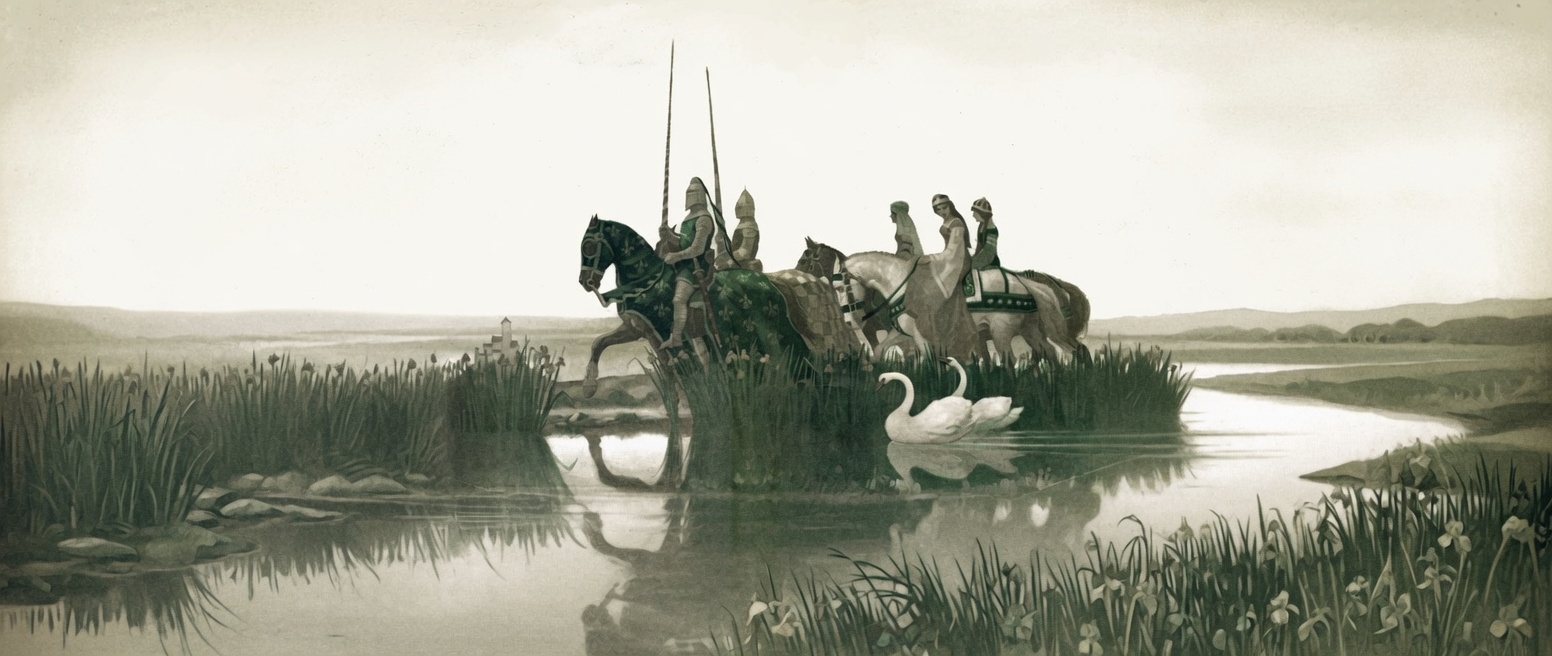
The hall empties into the wilderness. A map of the quest pattern from the Irish Otherworld journeys to the Grail romances — and where Suibhne's forced road fits within it.
"Each knight entered the forest at the point he himself had chosen, where it was
darkest, and there was no way nor path."
The vow, the riding out, and the record kept in hope — how the vision is answered by the road, and completed when the achievement is carried home and written down.
The vision does not stay in the hall, and neither do those who receive it. This page belongs
to the answer: what happens after the seeing — on the road, in the wasteland, and in the
record kept so the finding can wait for a reader not yet in the room.
The Shape of the Road
Vision mapped the first beat of the tradition's grammar: a seeing,
granted unbidden, that opens a gap. The quest is the second beat — the journey undertaken to
close it — and it is far older than the knights who made it famous. Medieval Irish
literature kept two whole genres for it: the echtrae, in which the hero is drawn
out of the human world into the Otherworld and comes back changed, and the
immram, the sea-voyage
through marvellous islands toward purification. The
structural constant is threshold-crossing: departure, a liminal country where the ordinary
rules are suspended, encounter and test, and a return that is never seamless. The road ends
at home or it is not finished — a claim the Grail tradition will keep to its last page,
where the quest is complete only when the tale has been carried back and written down.
What the Tradition Kept
Six elements recur in the Celtic quest-journey, and each survives — recognizably, sometimes
nearly word for word — in the Grail romances written centuries later.
Element I
The summons
The hero does not decide to journey and then meet the marvellous; the marvellous calls him out — an Otherworld woman, a mysterious rider, a vessel passing through the hall. The first beat belongs to Vision; this page begins where the hall empties.
Survives as the Grail’s appearing at Pentecost, and the vow.
Element II
The threshold
The boundary between worlds is mist, water, or forest. The Irish Otherworld is spatially ambiguous — beneath the earth, across the sea, or an invisible country coterminous with this one — so the crossing is a change of state, not of map.
Survives as the forest entered where it is darkest, and there is no way nor path.
Element III
The feast and the vessel
The Otherworld hosts a banquet around a sacred vessel. Máel Dúin’s voyagers find a cup that gives each person the food he most desires; in Baile in Scáil a maiden dispenses sovereignty from a golden cup, asking to whom it shall be given.
Survives almost verbatim in Malory: the Grail feeds each knight with such meat as he loved best in the world.
Element IV
The prohibition
The hero is bound by a geis — a sacred injunction to perform or refrain from one act, whose violation is catastrophe. Alfred Nutt read Perceval’s silence before the procession as an echo of exactly this compulsion.
Survives as the question that must be asked — or must not.
Element V
Time out of joint
Time flows differently across the threshold. Nera spends what feels like days in the síd while moments pass outside; the country of the quest keeps its own calendar.
Survives as the enchanted castle that vanishes at dawn, and the quest’s unnumbered years.
Element VI
The return
The tale-types end at home: the hero comes back bearing knowledge, objects, or a changed name — and the return is rarely seamless. The Otherworld leaves its mark on everyone it admits.
Survives as the one knight charged to ride back and tell it, so the clerks may write it down.
The Question, Not the Sword
The Grail tradition's decisive innovation belongs to Chrétien de Troyes (c. 1180–90): the
quest's success turns not on prowess but on asking the right question — a test of
the spirit conducted in speech. His Continuations made the stakes ecological: the question,
finally asked, restores the waters and the waste land blooms. Wolfram von Eschenbach
(c. 1200–10) turned the question inward and made it explicitly compassionate — "What
aileth thee, mine uncle?" — so that the healing act is attention to another's wound.
The great prose Queste (c. 1225–30) then recoded the whole apparatus as sacramental
pilgrimage: hermits follow every adventure with exegesis, and chivalric excellence itself is
judged insufficient — Lancelot fails by his adultery, Gawain by his worldliness, and the
virtues that open Corbenic are faith, chastity, and humility. Malory carried that verdict
into English as tragedy: the failure of the best worldly fellowship there ever was.
Jessie Weston's structural observation still holds even where her ritual theory has fallen:
across every version the task is double — heal the King, restore the Land — because the
king's wound and the land's barrenness are one sickness. What the road asks, in the end, is
mercy rather than force; the full movement from vow to mercy to testimony is the keystone's
argument, They Rode Out.
Where Suibhne Stands
The anthropologists gave the questing knight a name the Irish already had a figure for.
Victor Turner, reading initiation rites, called the initiand a liminal persona —
betwixt and between, stripped of rank and identity in a country outside the social order,
remade there before reincorporation. That is the Grail knight in the pathless forest; it is
also, exactly, the geilt. Suibhne crosses the same threshold as the knights, but
backward: not sworn out of the hall by a vision but flung out of it by a curse — feathered,
unhoused, wandering a wilderness he did not choose. The road is the same country either way,
and it does the same work. The knight seeks the Grail; Suibhne, in the treetops, composes
the poems — each wringing meaning from the barren place, each remade by a wilderness that
could not have done its work in the hall. And his road ends the way the tradition insists
every true quest ends: in mercy received small and daily — Moling's milk poured in the
hollow — and in a record commanded, so that the wild man's verses outlive the wild man. In
the arc this site reads — curse, exile, wandering, vision, restoration — the quest is the
whole middle of the tale, walked on foot.
The Fault Line
The scholarship behind this map has a live seam. The Celtic-origins line — Nutt, Loomis,
and most recently Carey — reads the Grail apparatus as Irish and Welsh inheritance: the
cauldron of plenty behind the vessel, the spear of Lugh behind the bleeding lance, the
geis behind the fatal silence. Its standing weakness is that no single Celtic text
is a direct parent; Loomis himself conceded the case is a patchwork of correspondences. The
opposing tradition reads the Queste as Cistercian theology built on Bernard of
Clairvaux, owing its visionary machinery to the cloister rather than the síd. The
working consensus splits the difference: a Celtic kernel, decisively reworked by Christian
hands. This page keeps both positions visible and marks the contested edges; the argument
about what the road asks belongs to the keystone, and the practice the road becomes —
prayer, attention, craft — belongs to Take Flight.
This page reads across versions rather than any single text. The vow, the parting at the
forest, and the record carried home come from the prose Queste; the healing
question belongs to the earlier Perceval line. The braid is deliberate, but the seams are
marked rather than smoothed over.
Related
Vision — the hall, the summons, the coal to the lips
How and when we met, our wedding at the Wayfarer's Chapel, and the journey toward a home — mercy begun as a life built after the wilderness instruction to forgive.
creative-nonfiction identity marriage wayfarers-chapel
References
The texts and scholarship behind the map above. Because this page reads across versions and positions, each source is tied to what it actually supplies; where a thesis is contested or a quotation not yet settled, it is marked.
Mary Williams, "Some Aspects of the Grail Problem," Folklore 71 (1960) — the working consensus: the kernel of the Grail legend is Celtic; its literary form is Christian, courtly, and authorial.
Chrétien de Troyes, Perceval, ou le Conte du Graal (c. 1180–90), and its Continuations — the unasked question at the Fisher King’s table, and the Waste Land restored when it is finally asked.
Wolfram von Eschenbach, Parzival (c. 1200–10) — the question made explicitly compassionate: "What aileth thee, mine uncle?"
La Queste del Saint Graal (c. 1225–30) — the parting at the forest "where it was darkest, and there was no way nor path"; chivalric excellence judged insufficient; Bors charged to carry the tale back so Arthur’s clerks may record it. Wording of the epigraph to be settled against a single edition (Matarasso trans.) before it is quoted as final.
Victor Turner, The Ritual Process (1969), after van Gennep — the quester as liminal persona, betwixt and between, stripped of identity before reincorporation.