The keystone essay
Removing the Veil
The appearing before the quest — the veiled vessel, the faces made fair, and a covering that turns out to have been on the beholder all along.
Read Removing the Veil →
vision grail malory veil
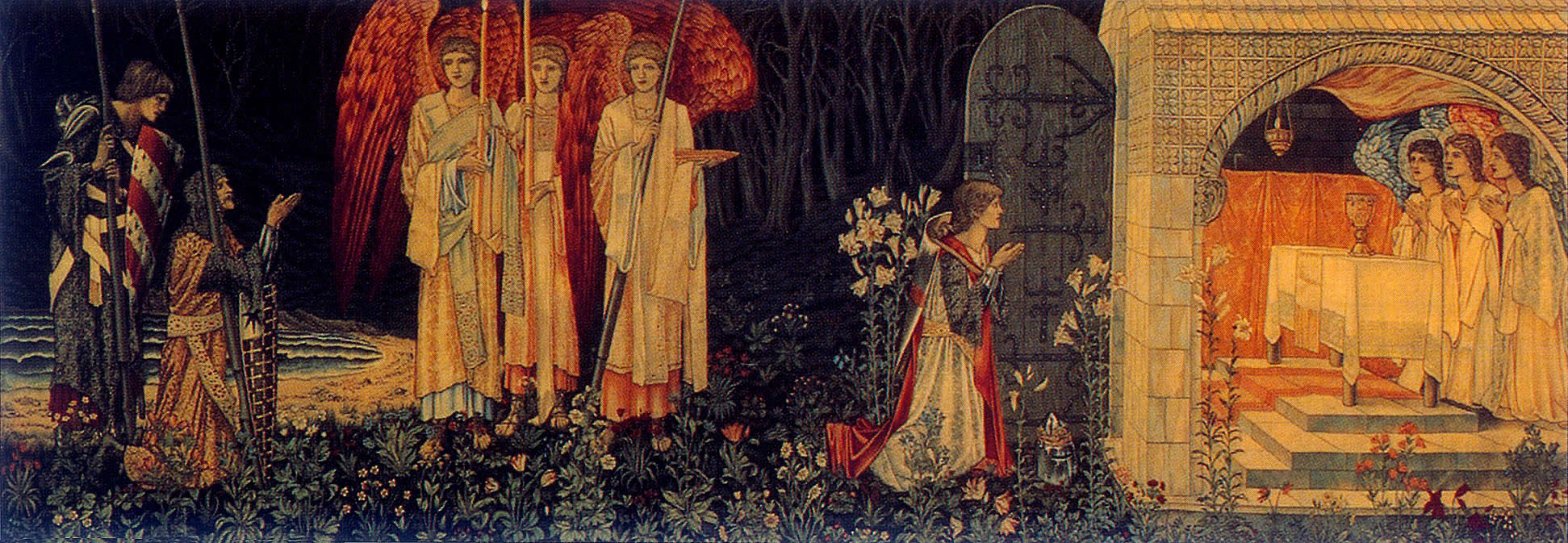
Before any quest, there is an appearing — the seeing that summons. A map of the vision-precedes-quest pattern across the Celtic and Arthurian tradition.
"But we all, with open face beholding as in a glass the glory of the Lord, are changed into the same image from glory to glory."
The keystone essay
The appearing before the quest — the veiled vessel, the faces made fair, and a covering that turns out to have been on the beholder all along.
In Arthurian and Celtic story the road almost never begins with a decision. It begins with a sight — a dream, an apparition, the glimpse of a beloved, the pass of a veiled vessel — and the sight is not scenery. Across the tradition the tales keep a two-beat grammar: a vision granted, then a journey to close the gap the vision opened. The gap may be a woman never yet met, a kingship not yet taken, or a glory seen only under its covering; the failure, wherever it comes, is seeing without understanding — Perceval's silence, Arthur's misread dreams — and the achievement is correct seeing, which is why the last knight standing at Corbenic is the one permitted simply to look.
The two-beat grammar is a synthesis drawn across the sources below, not a documented consensus — the seams, as elsewhere on this site, are marked rather than smoothed over.
The seeing that summons recurs in four forms, from the earliest Irish Otherworld tales to the great prose Queste.
Form I
Conn of the Hundred Battles, keeping dawn watch on the ramparts of Tara, is drawn into a mist and into an Otherworld hall, where a phantom and a sovereignty-maiden prophesy the kings who will descend from him. The vision does not send him searching; it confers a destiny he must then live out — the political shape of the quest.
Baile in Scáil; Baile Chuinn Chétchathaig
Form II
The emperor Macsen dreams of a maiden in a far castle, wakes consumed, and sends messengers across the world to find her. Culhwch is fated to love Olwen, whom he has never seen, and the naming alone launches the impossible tasks. One scholarly line derives Perceval himself from a Celtic quest for a dream-maiden.
Breuddwyd Macsen Wledig; Culhwch and Olwen; Owen (1959), contested
Form III
At the Fisher King’s table the grail procession passes before Perceval, and his silence — seeing without asking — creates the whole ongoing quest. Later, three drops of blood on snow entrance him: the moment image and meaning first coincide, and the hero learns what looking is for.
Chrétien de Troyes, Perceval; Welsh Peredur
Form IV
The prose Queste is the densest dream-country in the whole cycle: visions steer, warn, and rebuke knights who mistake the quest for an ordinary adventure. The quest itself is vowed as a desire to see the Grail more openly than it showed itself — and it ends only when one knight is permitted to look inside.
Queste del Saint Graal
The pattern holds because the medieval mind had a doctrine of seeing. From Macrobius the Middle Ages inherited a taxonomy of dreams that separated the veridical kinds — the somnium, the visio, the oraculum — from the meaningless; and a vision of the true kind was not a private curiosity but a communication from beyond the world's edge. To receive one was to incur an obligation. That is what makes the motif load-bearing rather than decorative: the quest is not an adventure the hero invents afterward. It is the debt the seeing creates.
The Irish tradition names these tales with a telling word. Baile in Scáil — the sovereignty vision at Tara — is "The Phantom's Frenzy"; the same word family gives the visionary-prophetic tales their genre title, and it gives this site's tale its name: Buile Suibhne, the Frenzy of Suibhne. Madness and prophetic vision are filed under one word. The geilt in his trees — stripped of hall, kin, and reason — stands at the wild edge of the same tradition: a man driven out of every comfort who is given, in a beloved face remembered or a stand of trees at evening, a piercing sight the comfortable never receive. In the arc this site reads — curse, exile, wandering, vision, restoration — this is the fourth station, and the tradition's own vocabulary says it was never far from the third.
The scholarship behind this map carries a live disagreement. One line — Owen, Carey — argues that Grail romance descends from specific Celtic vision-tales: the dream-maiden, the Otherworld prophecy-visit. Another — Pauphilet, Pratt — reads the Queste's visionary machinery as Cistercian theology, built rather than inherited. Most current scholars accept something between: a shared narrative type, decisively reworked by Christian hands. This page maps both positions and marks the contested edges; what the seeing is — the one light, graded to the beholder, perceived in faces — is the keystone's argument, Removing the Veil. What follows the seeing — the vow, the road, the record — belongs to Quest.
An identity essay
IV · Recognition
Philokalia means love of the beautiful. Finding the book, reading it against the uncreated light, and recognising in three faces the same light shown according to what each could bear.
The texts and scholarship behind the map above. Where a source is cited without a confirmed byline, or where a claim is synthesis or interpretation rather than finding, it is marked.