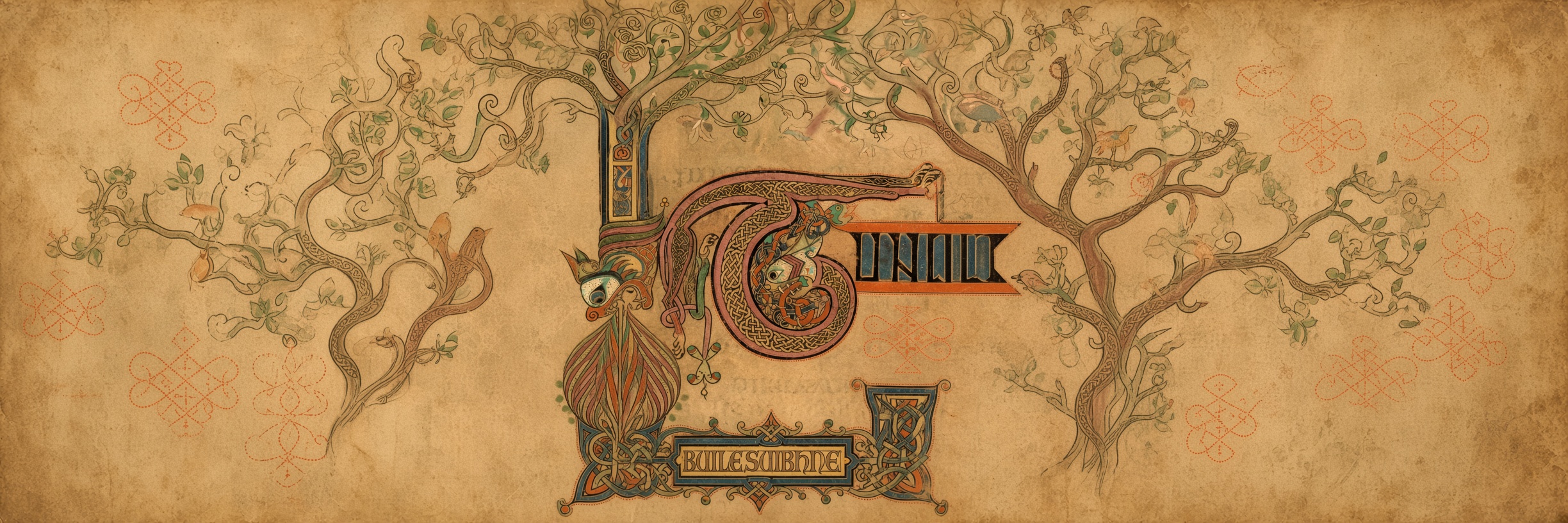
Buile Suibhne — The Frenzy of Sweeney

The medieval Irish tale of a king driven into the trees — the text, the tradition, the manuscripts, and where to read him.

text myth poetry geilt manuscript

The Tale in the Tree

Somewhere in Ireland, late in the twelfth century, a monk sat down in a scriptorium — possibly at Armagh — and wrote out the strangest story his tradition owned: the tale of a king who threw a saint’s psalter into a lake, was cursed for it, went mad at the sound of a great battle, and lived out his years in the trees. Not as a beast — that is the modern misreading — but as something the Irish had a precise word for: a geilt. A man so shattered by battle that terror lifts him out of the human world; who grows light, leaps like a bird from tree to tree, shuns men, eats watercress from the streams — and speaks poetry. The best nature poetry in the language, the tradition insisted, comes out of that broken mouth.

The story is called Buile Suibhne — the Frenzy, or Madness, of Suibhne. Suibhne is my name: anglicized, Sweeney. The whole of this website grows out of the tale the way the tale says the madman lived: up a tree, rooted in one story, looking out over everything.

This page is the study — the tale itself, the man behind it (if there was one), the wild-man tradition he belongs to, the manuscripts that carried him to us, and where to read him. The retelling — the story from inside the wound — lives in Story.

The Text at a Glance

The Tale

Eight movements — long enough to be a clear short account of the tale, short enough to leave the door open into the novelization. As scenes reach finished form on the Story page, each beat below becomes a door into the retelling.

I · The Psalter in the Lake

Rónán Finn, a saint, comes marking out a church in Suibhne’s territory without the king’s leave. Suibhne, enraged, goes out naked to drive him off, seizes the saint’s psalter and hurls it into the lake. An otter returns the book unharmed — the tale’s first quiet miracle, water refusing to be an accomplice — but the offense stands, and Rónán’s curse is spoken: that Suibhne will wander the world naked and mad, as he came naked in his madness to the saint.

II · The Battle of Mag Rath

The high king Domnall and Congal Claen of Ulster meet at Mag Rath in 637, and Suibhne is in Congal’s host. Rónán, blessing the armies, is again wronged — Suibhne kills one of his psalmists with a cast of his spear and shatters the saint’s bell. The curse takes its occasion. When the hosts clash and the great cries go up on both sides — three mighty shouts — something in Suibhne gives way. His fingers loosen from his weapons; horror fills him; his body grows light. He rises out of the battle like a bird, and the tale says his feet scarcely touched the ground for trembling. He does not stop.

III · The Man of the Trees

Suibhne comes to rest in a yew, then wanders Ireland year upon year — Glen Bolcain in the north, the glen where Ireland’s madmen gathered, becomes his one poor home. He is a geilt now: feathered in the later tradition’s imagining, leaping the hills, starving on watercress and brooklime, freezing in the storms — and out of all of it, verse. The tale gives him the great poems: his lament for his lost kingship, his praise of every tree in Ireland by name and character, his terrible tenderness for the places that shelter him. The king who threw away a book of psalms becomes, against his will, a psalmist of the wilderness.

IV · Eorann

His wife. Twice the tale brings him circling back to her — once to find her living with the man who has taken his place. Their exchanges are among the most piercing in medieval literature: she says she would rather live in a hollow tree with him than in any king’s house; he, in his madness, both craves and refuses the human warmth that would tame him. He always returns to the trees.

V · The Pursuit

Loingseachan, his foster-brother and keeper, hunts him with patience and finally with a lie — telling him his father, his mother, his daughter, his son are dead — and grief drags Suibhne down out of the tree into captured sanity. For a season he is nearly himself. Then the hag of the mill goads him into leaping again, leap for leap across Ireland, and the madness takes him back whole.

VI · The Other Madman

In Britain, Suibhne meets his mirror: Fer Caille, Alladhán, a wild man of the Britons, cursed after his own battle. They keep each other’s misery company for a year, and part when Alladhán goes to his foretold death by drowning. The geilt, it turns out, is not an Irish accident but a whole northern tradition — see The Geilt below.

VII · Moling

At the end of his strength, Suibhne comes south to the monastery of Moling — Tech Moling on the Barrow. And here the tale turns toward its meaning: the saint does not cure him, does not cage him. He receives him. Suibhne is to wander as he must, but return each evening; and Moling commands that his story and his poems be written down. The cook Muirghil leaves him his supper of milk, poured into a hollow pressed in the dung of the byre — the king of Dál nAraidhe drinking from the humblest vessel in Christendom, and the tale offers it without mockery, as a kind of sacrament of lowliness.

VIII · The Death

Mongan the swineherd, Muirghil’s husband, in a fit of jealousy over the madman his wife feeds, puts a spear through Suibhne as he drinks. Dying, Suibhne is reconciled: he confesses, receives the sacrament from Moling’s hand, and dies leaning against the church door-post. The saint buries him with honor and speaks his elegy. The man who began the tale by throwing a psalter into a lake ends it inside the book — his frenzy, by Moling’s order, written down and kept. The manuscript you can read today is the keeping.

The Man Behind the Tale

The Geilt — Sweeney’s Kindred in the Wild

Suibhne is the greatest of a family of wild men that haunts the whole literature of the medieval north. The pattern repeats with the fidelity of ritual: battle, break, flight, wilderness, poetry or prophecy, and a saint at the end holding the door.

Ireland

Suibhne Geilt

Breaks at Mag Rath (637). Lives in the trees. Speaks the wilderness into verse. Sheltered at the end by Moling.

Wales

Myrddin Wyllt

Merlin before he was Arthur’s Merlin — breaks at Arfderydd in 573 and flees mad into the Caledonian forest, prophesying among the trees.

Scottish Lowlands

Lailoken

Does the same, and is sheltered at the end by Saint Kentigern as Suibhne is sheltered by Moling.

The tradition may have flowed from the Brittonic north into Ireland, or the two may branch from one older root; either way, the geilt is not a literary accident but one of the medieval world’s ways of saying something it knew and we have relearned: that battle can shatter a mind, that the shattered are driven to the margins, and that what they say from the margins may be worth more than what the sane say at the center. The tale even names the leaping madness as a known condition with a known refuge — Glen Bolcain, the glen of the mad, likely in north Antrim, where the broken of Ireland’s battles gathered.

The Book Itself — Manuscripts and the Scriptorium

Attend to how this story survived, because the survival is itself the story. The tale ends with a saint ordering a madman’s words written down. The tale exists because monks obeyed that kind of order for a thousand years. Its written form was composed in a monastic scriptorium — Armagh, perhaps — by an author who braided old traditions into the prosimetrum we have: prose to carry the events, verse to carry the soul. The story of the scribe-sheltered madman is, itself, a scriptorium artifact. When this site names its practice region the Scriptorium, this is the lineage it claims.

And the copies we have are late and few — three manuscripts, all from the anxious centuries after the Gaelic order fell. Think of what that means: the tale of Suibhne crossed five hundred years from its Armagh author to those copyists on scraps we no longer possess, and came within three manuscripts of never reaching us at all. Every page of this website is downstream of a handful of men with pens, copying by candlelight while their world ended.

1629 · Brussels

MS 3410 (L)

The oldest surviving copy — a condensed text written out by Mícheál Ó Cléirigh, chief of the Four Masters, racing to copy Ireland’s memory before it burned.

1671–74 · RIA

MS B iv 1 (B)

The fullest text — the Royal Irish Academy manuscript that carries the tale most completely into the modern editions.

1721–22 · RIA

MS 23 K 44 (K)

A third copy from the same anxious afterlife — proof that the keeping continued even as the Gaelic world that made the tale was ending.

Vision / Scriptorium: why the bench matters — the whole argument, from this one fact

Reading It — Editions and Doors

Essential · Free

J. G. O’Keeffe, 1913

Irish Texts Society vol. 12 prints the Irish and English on facing pages, with the Battle of Mag Rath told in the introduction. Long out of copyright. O’Keeffe’s prose is a century old and plain as oak; the plainness lets the strangeness through. This is where, in 1997, I first met my ancestor’s tale on a screen — a story told elsewhere on this site.

Modern door

Seamus Heaney, Sweeney Astray

The 1983 version is the reason most living readers know Suibhne at all — a poet of Ulster carrying a poet of Ulster across thirteen centuries. It remains in copyright; buy it, and read it second, after O’Keeffe, so you can watch what a great poet chooses to change.

A comparison essay belongs on the Sweeney book shelf.

The Long Echo

Few medieval tales have had a louder afterlife. Flann O’Brien set Sweeney raving in the scaffolding of At Swim-Two-Birds (1939), where the mad king’s verses interrupt a Dublin novel like weather from another century. T. S. Eliot borrowed the anglicized name for his brutal modern everyman — Sweeney apeneck, Sweeney erect — the geilt’s shadow falling on the twentieth century’s own broken soldiers. Heaney gave him back his own voice in 1983 and returned to him again in the “Sweeney Redivivus” poems. He has since wandered into television and fantasy, a leprechaun-tall unlucky god in American Gods, still cursed, still leaping. The tradition keeps doing what Moling commanded: writing him down again in every generation’s hand.

1939

Flann O’BrienAt Swim-Two-Birds: Suibhne’s verses break into a modern Dublin novel.

1919–1932

T. S. Eliot — Sweeney as modern everyman; the geilt’s shadow on the century’s broken soldiers.

1983–

Seamus HeaneySweeney Astray and the later “Sweeney Redivivus” poems restore the voice.

2001–

Popular afterlife — still leaping into fantasy and screen: cursed, unlucky, and remembered.

This site is that command obeyed once more — by one of his own name. The retelling begins at the moment everything broke.

Explore Further

Sources & Further Reading

Updated 2026-07-09