The Front Hall
Say the name the old way: Mac Suibhne — mock SIV-nya, roughly, though Donegal and Argyll would each correct you differently. Son of Suibhne. The English wrote it Sweeney, MacSweeney, McSweeney, Swiney, and a dozen ways besides, and carried it in ships’ manifests to every country that took the Irish in.
It is not a common kind of name. Most Gaelic surnames descend from a king, a saint, or a trade. This one descends from a word that means something like well-going, pleasant — and it hangs on the family like an heirloom with a story attached, because the most famous Suibhne in all of Gaelic literature was neither well-going nor pleasant. He was a king who was cursed by a saint, broke at the battle of Mag Rath, and lived out his days mad in the trees, speaking poetry. Centuries after that story was first told, a warrior lord in Argyll bore the name, built the oldest stone castle on the Scottish mainland, and founded a clan that would lose that castle, cross the sea to Ireland, and rise again as the axe-bearing aristocracy of Donegal.
This page is the house itself: where the name comes from, how the family branched, what it built and lost, and where it is now — which is to say, everywhere. The deeper stories each have their own rooms. This is the front hall.
The House at a Glance
MacSweeney heraldry is well attested — boar imagery and various mottos circulate — but internet heraldry is a swamp of gift-shop inventions. The note below states what the arms declare; the exact blazon still wants verification against a reliable armorial before it is treated as settled.
The Arms of the House
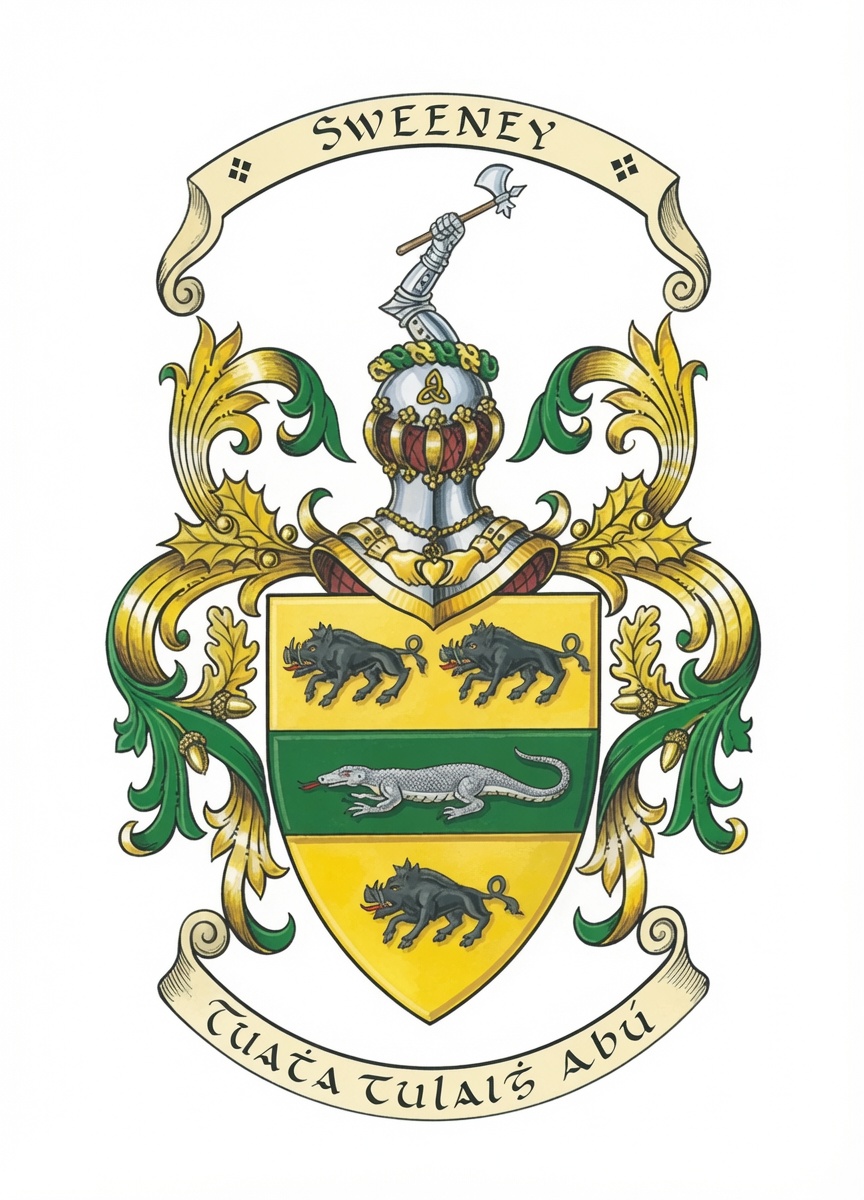
A coat of arms is not a family history compressed into proof. It is closer to a declaration: this is the creature, weapon, color and story through which a house wished to be known.
The MacSweeney arms — as commonly shown — carry the boar, the battle-axe, and a silver creature that refuses easy naming, set against green. Fanad, Doe, and Banagh arms are said to differ in detail; until each sept’s blazon is checked against the Chief Herald of Ireland’s registrations, Burke, or another documented armorial, treat circulating internet versions as provisional.
What the charges declare, even before every line is verified, is a chosen story. The axe is the gallowglass trade made visible. The boar belongs to battle-fury and otherworld force in Celtic iconography — a reading of how a warrior house wished to be known, not a certificate of pedigree. The wild king of Mag Rath is not proven by the shield; he is invited by the name the house already carried, and by the pattern the house lived. Heraldry here is aspiration made visible: genealogy, legend, and spiritual claim may blur; the decision to keep creature, weapon, and color does not.
The honesty about the two Suibhnes — blood line to Argyll, name-and-pattern claim to the geilt — is the section below. The arms sit with that honesty, not above it.
Two Suibhnes, One Inheritance
Two men named Suibhne stand at the head of this family’s story, and honesty requires saying plainly that they are not the same man, and that only one of them is an ancestor by blood.
The first is Suibhne Geilt — Sweeney the Mad — the seventh-century king of Dál nAraidhe who struck the saint Ronan’s psalter into the lake, was cursed for it, and broke at the battle of Mag Rath in 637: leapt from the slaughter, levitated on terror and grace, and lived out his years as a wild man of the trees, half bird, half penitent, speaking the most piercing nature poetry in the Irish language, until a saint named Moling took him in at the end and wrote his story down. That story, Buile Suibhne, is retold on the Story pages of this site; it is the reason this site exists.
The second is Suibhne of Argyll, a Norse-Gaelic lord who flourished around 1200, built Castle Sween on the shore of Knapdale, and gave his name to Clann Suibhne — the clan whose documented line runs down through the gallowglass lords of Donegal to the MacSweeneys and Sweeneys of today. Tradition carries his ancestry back through Anrothan, a prince of the northern Uí Néill who crossed to Scotland in the eleventh century, to Niall of the Nine Hostages himself — which would make the clan’s deepest root Irish after all: Ireland to Scotland and back again, a name that went out and came home.
Six centuries separate the mad king from the castle-builder. What joins them is the name, kept alive in a tradition that believed names carry fate — and the pattern. A house named for a Suibhne was driven from its stone home, crossed the water, wandered into new territories, kept poets, kept a book, and was itself sheltered and remembered in writing. I claim the geilt as ancestor of the name and the pattern; the lords of Argyll and Donegal as ancestors of the blood; and I decline to pretend the tradition is tidier than it is. It is better than tidy. It is true, and stranger.
→ Sweeney: why this author · Buile Suibhne · Battle of Mag Rath · Scriptorium: Suibhne, Myrddin Wyllt, and Lailoken
From Niall to the Crossing
The family’s own sixteenth-century historians traced the line like this. At the root, Niall of the Nine Hostages, the semi-legendary king from whom the Uí Néill high-kings of Ireland descended. From his northern branch, in the eleventh century, a prince called Anrothan crossed the North Channel and married into the lordships of Argyll — and from Anrothan, Scottish tradition derives a whole kindred of clans: Lamont, MacLachlan, MacEwen, MacNeill, and ours.
Around 1200, Anrothan’s descendant Suibhne raised Castle Sween in Knapdale. His son was Maol Muire an Sparáin — of the Purse; his grandson Murchadh entered the Irish annals in 1267, dying a prisoner of the Earl of Ulster. Within two generations the Stewarts and the wars of Bruce had stripped the family of Knapdale; a last attempt to retake Castle Sween by sea around 1310 failed and is remembered in a poem in the Book of the Dean of Lismore. By about 1314 Murchadh Mear — the Mad, the Rash; the name Suibhne’s shadow already showing — had planted the family in Fanad, in Donegal, as professional soldiers.
From him, everything: the three lordships, the castles, the book, the diaspora, and every Sweeney reading this page.
→ The Gallowglass: what the family became in Ireland, and how the trade worked
The Septs of the Name
Fanad
Mac Suibhne Fánad
The senior house, at Rathmullan on Lough Swilly. Patrons of the priory, commissioners of the family book; their peninsula still bears the family’s territorial memory. From Rathmullan’s own shore, in 1607, the Earls sailed out of Ireland — the senior seat of the name watched the Gaelic world end from its beach.
The Territories
Mac Suibhne na dTuath
Sweeney Doe, of Doe Castle on Sheephaven: foster-fathers of Red Hugh O’Donnell, shelterers of the Armada’s survivors, last to march out to Kinsale.
Banagh
Mac Suibhne Bóghaineach
Sweeney Banagh, under Slieve League at Rahan Castle: the southern house, bearers of the stone of Colum Cille to war.
And beyond Donegal, the name branched the length of the western seaboard as the trade spread: MacSweeney captains in Connacht serving the O’Connors and the Burkes of Clanricarde; in Thomond serving the O’Briens; in Desmond serving the MacCarthys of Cork and Kerry, where the name settled so deeply that Cork rivals Donegal for Sweeneys to this day. One family’s branching, drawn across the whole map of Gaelic Ireland — which is why the family’s own book named its history the Craobhsgaoileadh: the Branching-Out.
The Fall and the Scattering
The order that needed hereditary axes died at Kinsale in 1601, and the family’s world died with it — not all at once, but in the bureaucratic slow motion of confiscation, plantation, pardon, re-arrest, and forfeiture that filled the half-century after. The chiefs’ lands went in the Plantation of Ulster and finally, for the last holders, in the confiscations that followed the 1641 rising. Some of the name conformed and kept small estates; many took the old trade abroad, soldiering for Spain and France in the Irish regiments — the gallowglass profession outliving the country that invented it. The rest went into the tenantry of Donegal and Cork, and then, in the famine century, into the ships.
Today the name is scattered across Ireland, Britain, America, Canada, Australia — anywhere the Irish went, a Sweeney went. It has been carried by poets and boxers, admirals and archbishops, and by the fictional demon barber who borrowed it for menace. Every branch of that scattering leads back through Donegal or Cork, through the septs, through Murchadh Mear’s crossing, to the castle on the Knapdale shore.
The Clan Today
There is at present no recognized Chief of the Name. A petition to the Chief Herald of Ireland for recognition of a Doe-line claimant was lodged in 1999, but in 2003 — after a notorious scandal involving a fraudulent chiefly claim in another family — the Genealogical Office discontinued the practice of courtesy recognition altogether, and the question rests there: the chiefship of Clann Suibhne is dormant, not extinct, a door closed but not locked.
What the clan has instead is what it always had: the documents and the kin. The Leabhar Chlainne Suibhne sits in the Royal Irish Academy — it has its own page in this atlas — and Paul Walsh’s 1920 edition with full pedigrees is freely readable online. Clan associations have gathered and published genealogical research for decades. And the Sweeney surname DNA project now does with genetics what Tadhg mac Fithil did with vellum — tracing the branching of the name back toward common ancestors in the medieval centuries, Argyll and Donegal legible in the blood. The Craobhsgaoileadh continues; only the medium has changed.
If you carry the name — Sweeney, MacSweeney, McSweeney, any of its spellings — this site is partly for you. Start here, then walk the rooms: the Scottish cradle, the Irish castle, the trade, the book, the poem, the bard, and the mad king in the trees at the beginning of it all.