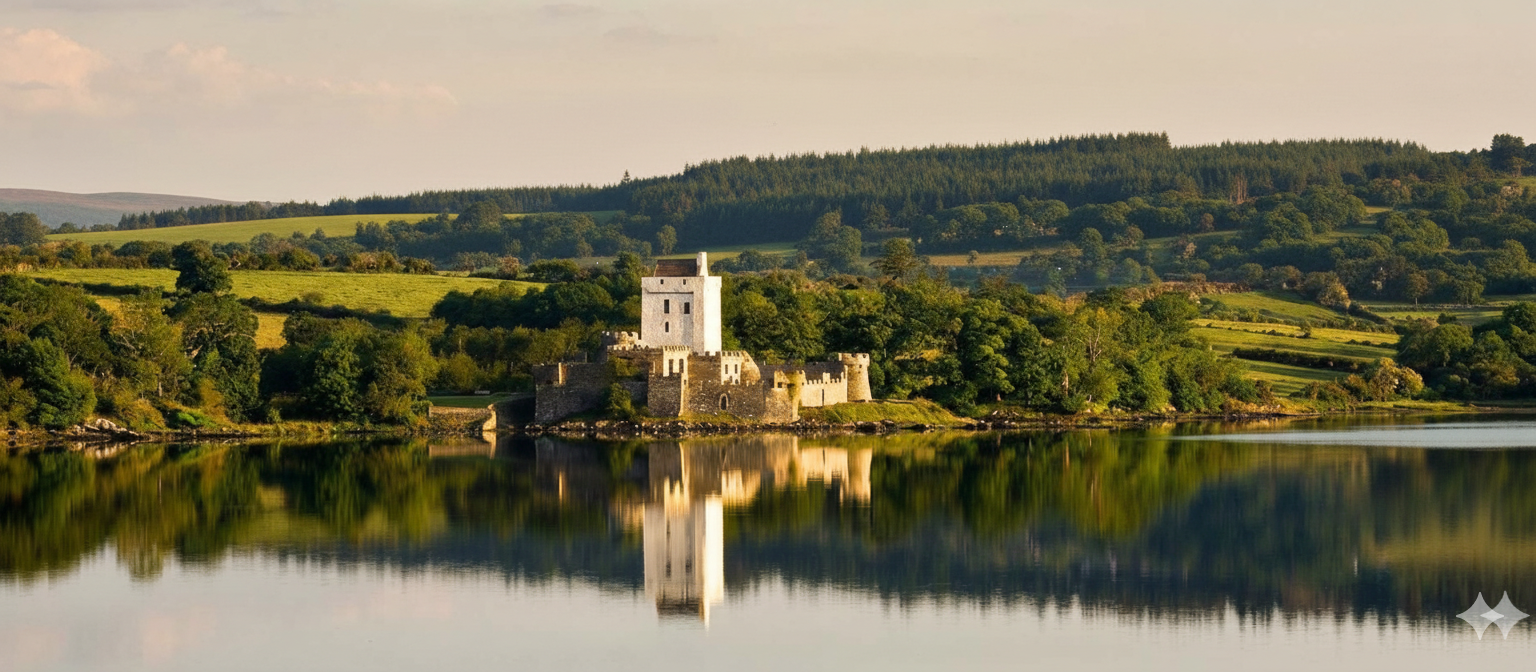
The Ballad of Turlough Óg and the Bardic Tradition
Turlough Óg is sung narrative anchored to place (Doe Castle) and clan memory (MacSuibhne / MacSweeney, Ó Baoill / O’Boyle)—a late echo of the older bardic world, less court-poem than vernacular ballad, but still carrying the same social work: naming lineages, marking power, and telling a moral history through story.
What It Is (and What We Can Document)
A key, citable witness is the National Folklore Collection / Dúchas record: a handwritten English text, collected in Clondahorky, Co. Donegal, dated 16 May 1939, by Seán Ó hEochaidh, with informant Niall Mac Giolla Bhríde. It shows the ballad circulating as folk narrative in living memory and being preserved through formal folklore collection.
Primary source: Dúchas record (CBÉ 0626, page 048). View on Dúchas.ie
Story Summary
Most versions present a tragic love story set against clan feud and castle authority:
- Turlough Óg Ó Baoill (O’Boyle) falls in love with Eibhlín / Aileen, associated with the MacSweeney household at Doe Castle.
- The relationship is forbidden, and the narrative turns on capture, killing, and grief.
- The story culminates in Eibhlín/Aileen’s death (often depicted as a leap from the tower), followed by the lovers’ burial together in the castle graveyard.
The ballad frames Donegal itself as witness—its hills, mist, streams—before bringing the listener into the “castle hall at Doe,” where personal love collides with clan power.
The Ballad (Manuscript Transcription)
Source: handwritten notebook pages 48–52 (Coimisiún Béaloideasa Éireann).
Editorial note: The manuscript’s spelling and capitalization are preserved as closely as possible; a couple of words are hard to read and are marked [?].
I
Wild are the hills of Donegal that towering darkly rise,
As if to greet the mists that fall upon them from the skies,
Dark dark the hills but darker still the mountain torrents flow,
Yet still more dark is Maolmuirrough’s heart in his castle hall at Doe.
II
Fair are the plains of Donegal and calm the winding streams,
Flow gently past each hut and hall beneath the sweet sunbeams,
But plain or stream or meadow green or flowers upon the lea
Were not more mild than Maolmuirrough’s child, so sweet and fair was she.
III
Stout grow thy oak oh! Donegal and straight thy ashen tree,
And swift and tall thy young men all their country’s pride to see;
But oak or ash or young men all that sprung from Irish soil,
Were not so strong straight swift or tall as the chief of Clan O’Boyle.
IV
He was the pride of Faugher near the hills of Ballymore,
For feats of strength none equalled him from Fanad to Gweedore;
And he would go through frost or snow on the merry Christmas day,
With ringing cheer to chase the deer from their haunts in dark Glenveigh.
V
And oft in Doe castle wood he’d hunt the deer and hare,
But the witching deer that brought him there was Maolmuirrough’s daughter fair,
And there was no man in all the land that trod on Irish soil,
Maolmuirrough’s daughter loved so well as Turlough Óg O Boyle
VI
In DunTally wood as best he could his love for her he vowed
But her father coming on the scene chased O’Boyle a**[?]**
In haughty pride he says abide at Faugher by the sea,
For you’ll never wed the daughter of Maolmuirrough an bhata shuidhe.
VII
In his little boat O’Boyle would float a-fishing he would go,
With hook and line to Lackagh stream that runs past Castle Doe.
For in the castle tower high his loved one was confined,
And on its lofty battlements in sorrow deep she pined
VIII
On the castle strand two boats lay manned to await the rising tide,
Maolmuirrough there in chief command right cowardly did hide.
And when O Boyle his homeward course steered by the Bishop’s Isle,
They there waylaid and a prisoner made of the fearless young O Boyle.
IX
He was brought into the castle in strong irons he was bound,
And by Maolmuirrough was confined in a dungeon underground,
And in a few days after enwrapt in funeral pall
Four stalwart ruffians bore a bier wrapt in a funeral pall
X
Poor Ellen from the tower high beheld the mournful scene,
In mute amaze she cast a gaze over the castle graveyard green;
There pale in death beside a mound of freshly risen soil,
The pall removed she recognised the features of O Boyle.
XI
Then with a scream she madly leapt from the tower to the ground,
Where by her faithful waiting maid her mangled corpse was found;
And in Doe Castle graveyard green beneath the mouldering soil,
Maolmuirrough’s daughter sleeps in death with Turlough Óg O Boyle
XII
And fishers say until this day a phantom boat is seen
By pale moonlight does gently glide along clear Lackagh stream,
And old men there with knowing looks, and with a cunning smile,
They say there go the lovers young Ellen and O Boyle.
XII (alternate version)
And fishers say along the beach a phantom boat doth glide,
In dead of night by pale moonlight along clear Lackagh tide;
And in the boat two figures sit and on each face a smile,
It is Maolmuirrough’s daughter fair and Turlough Óg O Boyle.
Bardic Lens: What Kind of "History" This Is
Think of Turlough Óg as place-memory wearing the clothing of romance:
- Genealogy and jurisdiction: names (Ó Baoill, MacSuibhne) do cultural work; they locate the story in a landscape of families, territories, and obligations.
- Castle-as-stage: the stronghold is not neutral scenery; it is the symbol of authority deciding who may love whom, who may live, and who may be remembered.
- Moral clarity through song: the ballad does what a chronicler sometimes cannot—it makes power felt, and so it endures.
Named Figures and Motifs
Figures commonly named:
Turlough Óg Ó Baoill (O’Boyle) — the tragic lover. Eibhlín / Aileen — the beloved, often pictured in a tower above Doe. Maolmuire (often styled “an bhata bhuí”) — the severe father figure in many tellings.
Motifs: the Donegal landscape as emotional prologue; tower / confinement imagery; public violence vs private devotion; graveside revelation / recognition.
Attribution
Different traditions circulate about “who wrote it.” One widely repeated note says it is believed to be by Davey Hayes, a travelling song-maker who sold songs at Donegal fairs in the early 20th century, and that it appeared in print (e.g., the Derry Journal). Regardless of composition origin, by 1939 the song exists as a collected item in Donegal tradition (Ó hEochaidh / Mac Giolla Bhríde witness). We treat Turlough Óg as a bardic-tradition descendant—a song with cultural authority in place and performance—while acknowledging that its exact composition trail likely includes print-and-fair circulation as well as oral transmission.
→ The Bard's Dilemma — the office of keeping story alive · Leabhar Chlainne Suibhne — the clan's kept poems · The Bard of the West — a named maker after the castles
References and Further Reading
Full text witnesses
-
Dúchas / National Folklore Collection — scan and record for Turlough Óg O’Boyle (CBÉ 0626, p. 048), with date, collector, location, and informant details.
https://www.duchas.ie/en/cbe/9001886/7320906/9117129 -
Lyrics witness (recording-linked transcription) — full lyric text as commonly sung/recorded (useful for comparing variants).
https://lyricstranslate.com/ro/triona-ni-dhomhnaill-turlough-og-oboyle-lyrics.html -
Folk-song research thread (Mudcat) — “Davey Hayes” / “Derry Journal” provenance note and synopsis of the feud framing.
https://mudcat.org/thread.cfm?threadid=47865
Listening
- Tríona Ní Dhomhnaill — The Keys Within (one of the better-known modern recordings).
Apple Music
Research leads
- Compare Dúchas scan vs recording-linked lyric — variant map: what stays stable, what shifts, and what that suggests about oral vs print transmission.
- Verify print appearance (e.g., Derry Journal) — archive lookup to confirm the folklore testimony.
- Informant/collector context — Seán Ó hEochaidh’s collecting work; Niall Mac Giolla Bhríde’s role as informant/poet (ainm.ie biography).
Suggested citation
Dúchas.ie (National Folklore Collection, UCD). “Turlough Óg O’Boyle.” Main Manuscript Collection, CBÉ 0626, p. 048. Collected by Seán Ó hEochaidh, 16 May 1939, Clondahorky, Co. Donegal; informant Niall Mac Giolla Bhríde.
https://www.duchas.ie/en/cbe/9001886/7320906/9117129