At the Shore
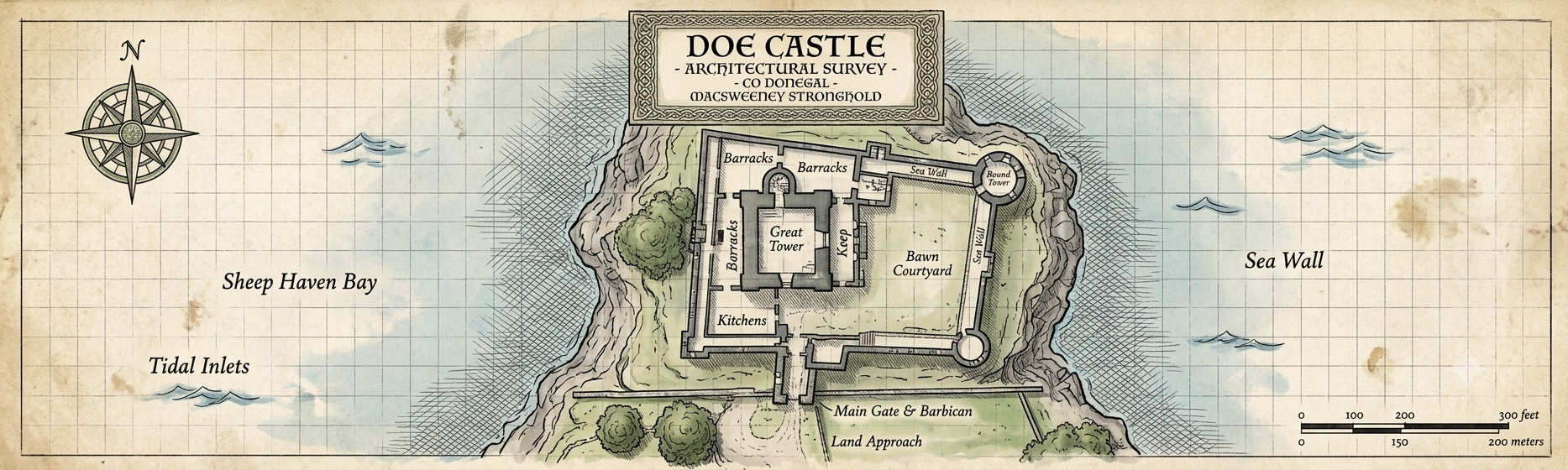
Doe Castle (Caisleán na dTuath — “Castle of the Territories”) stands on a rocky peninsula in Sheephaven Bay near Creeslough, County Donegal. Sea guards three sides. A deep rock-cut moat guards the fourth. You choose when the land connects.
Held for nearly two centuries by the MacSweeneys — Scottish gallóglaigh who became Gaelic lords of the northwest — Doe anchors the MacSweeney line in landscape and memory within the Sweeney in Flight project. It is the younger twin of Castle Sween on Loch Sween in Argyll — the Scottish house the warriors came from.
Doe is the northern of the two MacSweeney seats that survive by name in Donegal. Its counterpart is Rahan Castle on St. John’s Point, held by the Banagh branch — a sister stronghold of the same clan, on the far side of the county, that took the same losses and did not come through them.
Explore the Castle
Walk the structure virtually before reading further — a reconstruction of Doe Castle’s form and peninsula setting.
Timeline Snapshot
c. 1420–1440s
Castle likely constructed; by the 1440s it passes into MacSweeney control.
c. 1440s to early 1600s
MacSweeney Doe era; at least thirteen successive chiefs hold the fortress.
1588 to 1601
Armada survivors sheltered; Red Hugh O’Donnell fostered; MacSweeney forces march to Kinsale.
1613 to 1934
Crown seizure, planter ownership, Hart family tenure, then National Monument status.
Key Moments
Built around 1420 under Quinn or O’Donnell influence, Doe became the principal seat of Mac Suibhne na dTuath — the O’Donnells’ sword-arm in the northwest. These are the episodes that define its story.
Fosterage
Aodh Ruadh (Red Hugh O’Donnell)
The future Nine Years’ War leader was fostered with the MacSweeneys — a bond of fosterage tying clan to clan across the Gaelic world.
1588
The Armada at Doe
Chief Eoghan Óg II reportedly sheltered Spanish Armada survivors — a family habit of harboring the shipwrecked. Armada page →
1601
Kinsale and the long defeat
Maolmhuire an Bhata Bhui marched with Red Hugh to Kinsale — the battle that broke the northern confederacy and began the end of Gaelic lordship.
1544
MacSweeney grave slab
A carved grave slab, now in the restored keep, remains material evidence of elite MacSweeney patronage and status.
After Gaelic Lordship
7 March 1613
Granted to Sir John Davies, Attorney-General for Ireland.
July 1642
Owen Roe O’Neill landed at Doe with Spanish-trained officers.
1650
Captured by Sir Charles Coote.
1934–1990s
National Monument; Hart family occupation; major tower-house restoration.
Doe endured where other tower-houses fell — its peninsula setting, continued occupation, state protection from 1934, and the 1990s restoration explain why the keep still stands.
Architecture and Defences
Doe’s defences begin before the masonry: the headland is the first wall. What the builders added was a layered answer — moat, bawn, keep.
The Headland
Sea on three sides; tide, rock, and open water do half the defensive work before stone is laid.
Moat & Approach
A rock-cut moat, once crossed by drawbridge, separates castle from mainland — you cross when the land connects.
Keep & Bawn
Four-storey tower house within a curtain wall with musketry loops — layered defence for a headland exposed to sea and land alike.
MacSweeney Doe Chiefs
Doe Castle was held by at least thirteen successive MacSweeney Doe chiefs across roughly two centuries. A verified chief-by-chief sequence with citations is in development.
Working notes on succession
- Eoghan Óg II — associated with sheltering Spanish Armada survivors, 1588.
- Maolmhuire an Bhata Bhui — final pre-Plantation phase; marched to Kinsale, 1601.
- Full sequence forthcoming on the MacSweeney Clan page.
Folklore and Ballad
Visit Today
Grounds
Open free to the public daily, year-round.
Tower house
Guided tours by appointment — 48 hours notice preferred. doecastlecreeslough@outlook.com
Explore Further
- Castle Sween — the Scottish cradle, Doe’s older twin →
- Rahan Castle — the southern house, seat of Mac Suibhne Bóghaineach →
- The Gallowglass — Gallóglaigh →
- MacSweeney Clan Atlas →
- 1588: Spanish Armada in Donegal →
- The Ballad of Turlough Óg →
- Photography: Ozgun Ozdemir →
Map & Landscape
Suibhne's Flight 637
- Dál nAraidhe Landscape
The east Ulster kingdom the tale gives Suibhne mac Colmáin. It is here he goes out naked to drive off Rónán Finn and throws the saint’s psalter into the lake — the offence the curse answers. The kingdom’s extent is approximate; the king lists know no Suibhne at that date. - Mag Rath · Mag Roth · Moira, Co. Down Battle
The Annals of Ulster record the battle under U637.1 — attestation, not story. In Buile Suibhne it is the hinge: three great shouts go up, the king’s fingers loosen on his weapons, his body grows light, and he rises out of the battle like a bird. Moira is a strong traditional association, not a settled site. - Glen Bolcain Landscape
The glen where Ireland’s madmen gathered, and the geilt’s one poor home — watercress, brooklime, and the great tree poems. The tale places it in the north; tradition looks to north Antrim. Marked here near Rasharkin as tradition suggests, not as fact. - Britain Landscape
Where Suibhne meets his mirror: Alladhán, a wild man of the Britons, cursed after his own battle. They keep each other’s misery a year and part when Alladhán goes to his foretold drowning. The tale says only "Britain"; scholars trace the geilt motif to the Brittonic north, so the marker sits on that coast. - Tech Moling · St Mullins, Co. Carlow Sanctuary
Moling’s monastery on the Barrow. The saint does not cure him and does not cage him — he receives him, lets him wander, and orders his story and his poems written down. Suibhne dies against the church door-post, reconciled. This site is that order obeyed once more.
The Crossing c. 1200 – 1314
- Castle Sween · Caisteal Suibhne, Knapdale Seat
The cradle. Suibhne of Argyll raised the oldest datable stone castle on the Scottish mainland here, and the clan took his name. Around 1310 John MacSween brought a fleet against his own ancestral castle to win it back, and failed — a raid remembered in the Book of the Dean of Lismore. After that there was no Scotland to return to. - Iona Sanctuary
Where the clan’s Scottish fathers were made and buried, before Kilmacrenan in Donegal took over the office. The family carried the shape of its inauguration across the water with everything else. - Fanad · Fánaid, Co. Donegal Landscape
The landfall. By about 1314 Murchadh Mear — Murchadh the Mad, the name’s shadow already showing — had planted the line in Fanad as professional soldiers. Exile becomes foundation: from him, the three lordships, the castles, the book, and every Sweeney since.
The Three Houses 1314 – 1600
- Rathmullan · Mac Suibhne Fánad Seat
The senior seat, on Lough Swilly. One hundred and twenty mailed gallowglasses owed to the O’Donnell; the priory endowed; Máire Ní Mháille’s commission of the family’s great manuscript. The last inaugurated lord of Fanad was still living in 1619. - Kilmacrenan Sanctuary
Where MacSweeney chiefs were inaugurated — the same ground on which the O’Donnells themselves were made. Hired swords do not get an inauguration site. Lords do. - Doe Castle · Caisleán na dTuath Seat
Sweeney Doe — Mac Suibhne na dTuath — on Sheephaven Bay: foster-fathers of Red Hugh O’Donnell, one hundred and twenty axes owed, the ornamented grave slab carved here in the high tide of the name. The last of them marched to Kinsale. - Dunfanaghy Landscape
The coastal landscape that frames Doe Castle’s story, and keeps its folklore. - Creeslough Landscape
The village at the head of the bay, grounding the castle in a place people still live. - Tory Island · Toraigh Sanctuary
An island of hermits off the Donegal coast, where the scribe Ciothruadh Mág Fhionngoill wrote the Leabhar Chlainne Suibhne for Máire Ní Mháille — a warrior household’s book of piety, in Irish. The family library begins here. - Rahan Castle · Mac Suibhne Bóghaineach Seat
Sweeney Banagh’s seat near Dunkineely, under Slieve League. Sixty axes owed — and one man to carry the mail shirt and the stone of Colum Cille. They bore the saint’s relic to war. - Slieve League · Sliabh Liag Landscape
The sea cliffs that wall the Banagh lordship, and mark the end of the Donegal coast the name held.
The Armada Year 1588
- Loughros Peninsula Wreck
La Duquesa Santa Ana driven ashore on the Loughros shore. Donegal commemoration remembers the survivors moving overland under the protection of "McSweeny na Doe" — a broader pattern in which MacSweeney authority is remembered as active, not merely passive, in the survivors’ story. - Doe Castle · Caisleán na dTuath Seat
Heritage Ireland’s own record for the castle states it plainly: the MacSweeney chief Eoghan Óg II gave shelter here to survivors of the 1588 fleet. Which ship’s men, how many, and what became of them, the record does not say. - Killybegs Harbour
The galleass La Girona anchored here damaged and crammed with survivors off other wrecks. MacSweeney Bannagh aided the Spanish and supported the repairs. She sailed for Scotland on 25 October. - Lacada Point · Port na Spaniagh, Co. Antrim Wreck
The night after leaving Killybegs, La Girona broke on the rocks below the Causeway headland. Of roughly thirteen hundred aboard, a handful reached shore. The repair at Killybegs bought them one day.
The Scattering 1598 – 1820
- The Yellow Ford Battle
O’Neill and O’Donnell’s great victory on the Blackwater — the old trade’s last full triumph, three hundred and forty years after the first Hebridean axes came to Ireland in a princess’s dowry. - Kinsale Battle
The chiefs of the name marched the length of Ireland in winter and shared in the defeat that ended the world that employed them. After Kinsale there is no Gaelic order left to need a hereditary axe. - Rathmullan · Mac Suibhne Fánad Seat
1607: from this shore the Earls sailed out of Ireland. The senior seat of the name watched the Gaelic world end from its own beach. - Cong Landscape
Mícheál Mac Suibhne was born at Funshinaugh near the ruined abbey of Cong — of a branch that tradition holds came west from Ulster generations before, refugees of the Cromwellian settlement. - Cleggan Landscape
The Atlantic edge of Connemara the Bard of the West is most associated with. A blacksmith at the forge in Irish-speaking Iar-Chonnacht, making songs a whole district kept by heart. The axe becomes the song. - Clifden Landscape
He is believed to have died at Fahy, near Clifden, around 1820. His burial place is unknown. The Bard of the West left no monument but his songs — the only monument a bard was ever meant to leave.
Further Reading
- Heritage Ireland: Doe Castle
- Go Visit Donegal: Coastal Castles
- Dunfanaghy: Doe Castle
- Dublin Penny Journal — nineteenth-century antiquarian accounts (National Library of Ireland, Internet Archive)