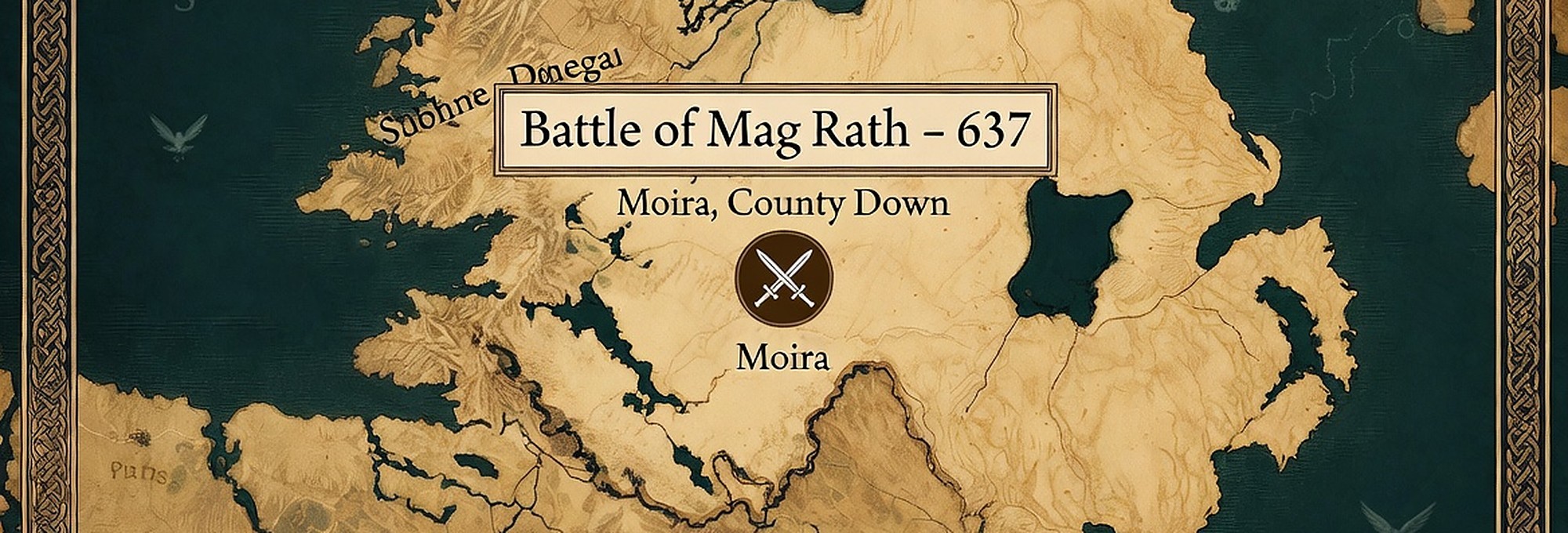
The Battle of Mag Rath (Mag Roth)
Summer 637. A battle remembered as a hinge-point in early medieval Ireland—and, in the Suibhne tradition, the event that shatters kingship into exile.
This page is written as an authoritative research scaffold for Sweeney in Flight and for my prose retelling. I keep three layers distinct:
- Record: annalistic/early witness (chronological anchor; minimal narrative)
- Memory: saga tradition (Cath Maige Rátha; speeches, motives, set pieces)
- Meaning: interpretation for Suibhne (how the battle becomes the engine of the Buile tradition)
At a glance
- Date: traditionally placed in 637 (annalistic dating)
- Names: Mag Rath / Mag Roth; often called “Battle of Moira” in later usage
- Why it’s famous: remembered as a decisive contest shaping northern power and alliance patterns
- Why it matters here: the narrative hinge that launches Suibhne’s “flight” into the wild
- What remains debated: the precise battlefield site; later tradition’s scale and detail
What the annals and early witnesses actually say
The annals: attestation, not story
The Annals of Ulster record Mag Roth under U637.1 1 . Like many annal entries, this functions as attestation more than story: it anchors the event chronologically without supplying speeches, troop counts, or scene-by-scene narrative.
A practical rule for this page:
- When the annals are silent, detailed narrative belongs to the saga layer unless corroborated elsewhere.
- When later texts offer vivid description, treat it as meaning-making rather than battlefield reportage.
Adomnán and the Columban world (context witness)
Adomnán’s Life of St Columba is not a battle chronicle, but it is a near-contemporary witness to the moral and political imagination of the era: kingship, sanctity, patronage, and the spiritual framing later tradition often applies to conflicts like Mag Rath.
Political context (why Mag Rath happens)
Mag Rath belongs to a world where authority is maintained through alliance networks, coercion, and reputation, and where the Irish Sea is a strategic corridor rather than a boundary. Even when saga tradition dramatizes motives, the underlying structure is recognizably political:
- competing claims of overlordship
- fosterage ties and betrayals (a recurring theme in Irish political storytelling)
- ecclesiastical influence on legitimacy and memory
Cath Maige Rátha (the battle as saga)
Cath Maige Rátha names a literary tradition that expands Mag Rath into speeches, motives, champions, omens, and set pieces 2 . This is not “fake history”—it is cultural memory shaped into narrative.
How I use it:
- as evidence for how later Ireland remembered Mag Rath
- as a source of narrative logic and imagery for a modern retelling
- but not as a stenographic record of 637
Why Mag Rath matters to Buile Shuibhne
In Buile Shuibhne, Mag Rath is not merely backdrop. It is the trigger event that turns sovereignty into exile.
Across versions, the story logic is consistent:
- Breach of the sacred: conflict with a holy figure; a curse as consequence
- War as sensory terror: noise, confusion, fear (the breaking point)
- Transformation: Suibhne becomes the wandering geilt
- Exile into place: woods, ridges, rivers become the map of inner ruin and survival
For my prose retelling, the key is to let multiple truths coexist:
- The battle carries historical gravity (politics, alliances, consequence).
- The curse carries mythic/spiritual truth (not reducible to superstition).
- Suibhne’s break must feel earned: escalating boundary-crossings culminating in battle-terror.
Where was Mag Rath?
Many modern summaries identify Mag Rath with the Moira area, but the precise site remains debated. Arguments often rely on place-name reasoning (toponymy), matching saga geography to modern terrain, and local/antiquarian reconstruction.
This page treats “Moira” as a strong traditional association while avoiding overclaims of definitive proof for any single modern feature.
Research notes for a modern retelling
Questions guiding my research and scene design:
- What would kingship feel like on the eve of battle—confidence, fear, or fatalism?
- Which details are annalistic anchors, and which are saga inventions that reveal cultural memory?
- How do I stage the curse and the battle-noise so Suibhne’s flight feels inevitable rather than sudden?
- What places and place-names become “charged” in Suibhne’s wandering, and why?
Notes
Claim-level notes identify the source and locator for consequential factual claims on this page.
- 1. Annals of Ulster, U637.1 , U637.1 ↩
- 2. Cath Maige Rátha, UCD/TLH translation witness , translation witness — The saga expands the event as cultural memory, not as a stenographic record of 637. ↩
References
The primary texts and editions behind the distinction between annalistic record, saga memory, and this page’s interpretation.