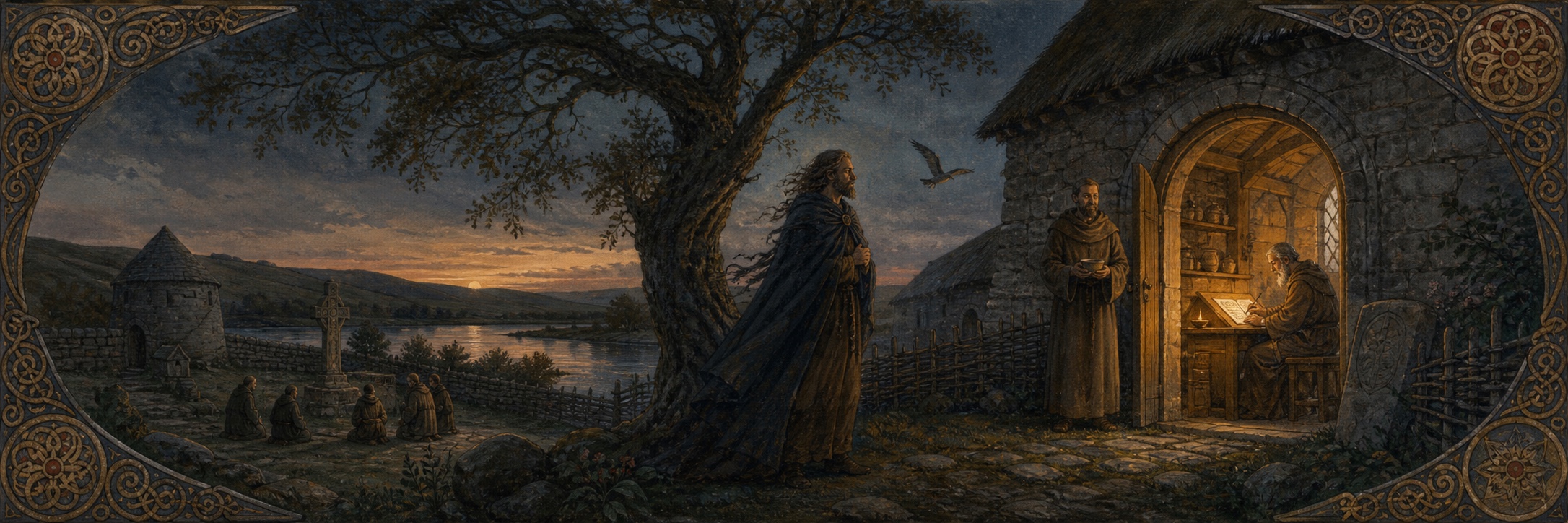
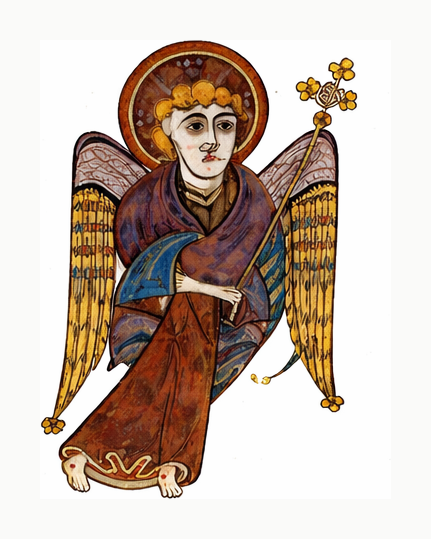
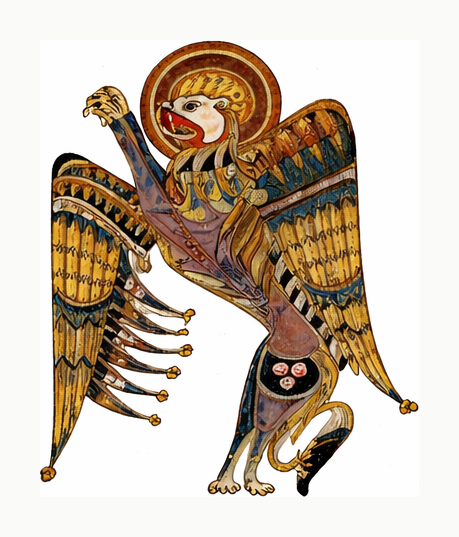
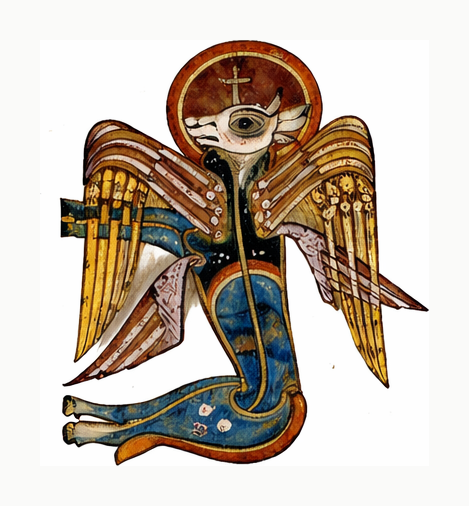
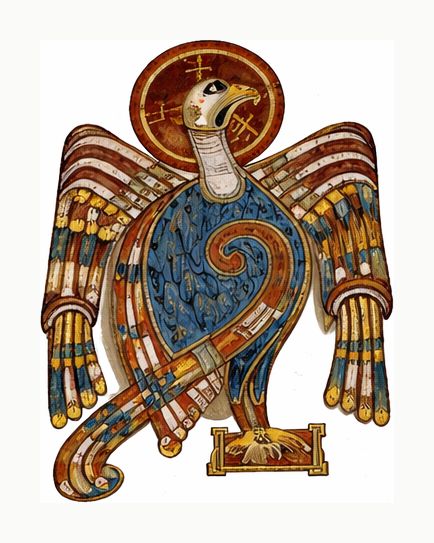
Reading, writing, and prayer as one practice. The history the name is drawn from — the houses, the hands, and the losses — with the Word-Hoard, the four wings of the Tetramorph, and the threads that cross between them.
"Qui scripsit scribat, semper cum Domino vivat."
Let the one who wrote it go on writing; may he live always with the Lord.
This Scriptorium is a working library: reading, writing, and prayer held within one vocation.
It is named for a discipline rather than a floor plan — the patient work by which a word is
received, tested, made, corrected, and kept for someone not yet in the room.
Enter through the Word-Hoard, where language makes access possible; continue into the four
wings of the Tetramorph; or follow a thread where one argument crosses several traditions.
Introductions establish what can be attested, studies provide a path through it, and
reflections ask what the learning requires of a life.
What the Tradition Attests
A practice, not a floor plan · c. 345–1500
The room is easy to picture: a long hall, slanted desks under narrow windows, hooded
copyists, a reader's voice measuring the silence. The medieval evidence for that hall is
thinner than the picture suggests. Some houses did set a room apart, but a great deal of
copying happened in cloister carrels, in libraries, in warmed rooms near the kitchen, or in
a monk's own cell. Isidore of Seville used scriptorium to mean a writing
instrument — a thing held in the hand.
What the record attests securely is not a building but an office: a set of practices by
which words were received, tested, copied, adorned, corrected, bound, and handed on. That is
the sense in which this library takes the name. What follows is the history the name is
drawn from — the houses, the hands, the materials, and the losses.
Two foundations, eleven years apart
The sixth century produced both the rule that made books necessary and the monastery that made
copying an argument. Neither man set out to invent a writing room; between them they made one
inevitable.
founded 529
Monte Cassino
Benedict of Nursia
The Regula Benedicti never names a scriptorium and never commands transcription. What it commands is reading: two hours of it daily, and one whole book to each monk through Lent. Chapter 48 sets the day as one fabric of prayer (opus Dei), sacred reading (lectio divina), and the labour of the hands — and the earliest commentators take copying to be the standard form of that labour. A house ordered this way needs books; before print, needing books means needing hands.
founded c. 540
The Vivarium
Cassiodorus Senator
A Roman statesman — quaestor, magister officiorum, praetorian prefect under Theoderic — retired to Calabria and built what Benedict left implicit. The Vivarium had a purpose-built scriptorium with sundials, a water-clock, and a lamp fed from its own reservoir so the work could outlast daylight. His Institutiones argued that monks should copy secular learning as well as scripture, and that a copyist was waging war: “Every word of the Lord written by the scribe is a wound inflicted on Satan.” He told his scribes to check against trustworthy exemplars, to emend the classics — and never to correct scripture for style.
The Insular houses
The most distinctive scribal culture of the early medieval West grew where Rome had been
briefest or absent altogether. Irish monasticism joined ascetic scholarship to
peregrinatio pro Christo, and the going-out carried the writing with it.
Iona
c. 563 · Columba
Mother house of the Columban familia. The Book of Kells was probably begun here in the late eighth century and carried to Kells in Meath between 807 and 814, after Viking raids. Recent scholarship argues the manuscript is the work of only two hands — a Scribe-Artist who wrote the text and a Master-Artist who made the major illuminations.
Lindisfarne
founded 635
Founded from Iona. The Lindisfarne Gospels, made around 700, join Celtic interlace, Germanic animal ornament, and Mediterranean motifs in one book. Its colophon names Eadfrith, bishop of the house, as sole maker — an extraordinary claim if it is accurate.
Monkwearmouth–Jarrow
Bede’s house · 673–735
Produced the Codex Amiatinus around 700 — the oldest surviving complete Latin Bible in one volume, at a cost of some 515 calfskins. Abbot Ceolfrith commissioned three; one survives, in Florence. Its frontispiece portrait of Ezra is thought to derive from a portrait of Cassiodorus: a line drawn straight from Calabria to Northumbria.
Bobbio
c. 614 · Columbanus
An Irish foundation in northern Italy, and a major preserver of classical texts. Irish willingness to travel — Luxeuil, St Gall, Bobbio — turned peregrinatio into a network of scriptoria laid across the continent.
The Insular script these houses developed — a half-uncial that held clarity
and ornament together — carried carpet pages, interlace, and animal ornament, worked in lapis
lazuli, orpiment, and verdigris. It is the hand this site's Celtic wing is named for, and the
reason the wing sits at the hinge.
The Carolingian reform, and the letters you are reading
Charlemagne's programme — the Admonitio generalis of 789, the recruitment of Alcuin
of York, the abbey schools — was the most deliberate state-sponsored copying effort of the
medieval West. Its most consequential product was a script. Carolingian minuscule emerged
from experiments at several houses, with a prototype at Corbie before Charlemagne's reign,
and Alcuin refined and spread it from Tours, where he was abbot from 796.
Italian humanists later found Carolingian manuscripts, mistook their clear letters for
ancient Roman ones, and built humanistic minuscule on them. Printers inherited that. The
lower-case forms on this screen descend, by several transformations, from a ninth-century
answer to a ninth-century problem.
It was also the bottleneck. The oldest surviving manuscripts of most classical Latin texts
are ninth-century Carolingian copies; what was not copied then generally did not survive at
all. Vikings burned the Tours scriptorium in 853.
Six offices
Where the work was divided, it was divided because each office guards a different way for a
book to fail. The division collapsed constantly in practice: the Lindisfarne Gospels appear to
be one man's work, and in a small house a single monk might hold all six.
Armarius
Also bibliothecarius. Directed the scriptorium, issued materials, controlled access to the books — and by the tenth century carried liturgical duties as well.
Scriptor
Copied the text, leaving blanks where decoration would go.
Rubricator
Added headings and initials in red lead. The practice named the office: rubrics, and the rubricator who supplied them.
Illuminator
Painted the initials, borders, and miniatures into the spaces the scribe had left.
Corrector
Read the finished copy against the exemplar. The office that refuses to let carelessness misrepresent a voice.
Binder
Sewed the quires and attached the boards — often at a different house from the one that did the writing.
What it cost the hand
Scriptoria were rarely heated and depended on daylight. Postures were held for hours. The
Rule of Saint Ferréol, around 560, put the equation plainly: he who does not turn the earth
with a plough ought to write the parchment with his fingers. The scribes agreed, and said so.
“Because one who does not know how to write thinks it no labour, I will describe it for you
… it mists the eyes, it curves the back, it breaks the belly and the ribs, it fills the
kidneys with pain, and the body with all kinds of suffering. Therefore, turn the pages
slowly, reader, and keep your fingers well away from the pages.”
Shorter voices survive in the margins, and they are not pious:
“Now I’ve written the whole thing. For Christ’s sake, give me a drink.”
“Oh, my hand.”
“I am very cold.”
“The parchment is hairy.”
“Thank God, it will soon be dark.”
“As the last port is sweet to the sailor, so the last line to the scribe.”
Both things are true at once, often in the same hand. Copying was understood as prayer,
as teaching that outlived the teacher, and — because it was cold, slow, and painful — as a
mortification worth offering. It was also, by the plain testimony of the men doing it,
miserable.
The parallel traditions
None of this was exclusively Western, and none of it was exclusively monastic. Four other
traditions ran alongside, on their own institutional logic.
Byzantine
The Stoudios monastery in Constantinople under Theodore the Studite (759–826) was the most important Byzantine scriptorium, and the one that legislated scribal attention most exactly: his Epitimia assign fifty genuflexions for making more glue than needed and letting it spoil. Stoudios is also tied to the ninth-century adoption of Greek minuscule — the Eastern parallel to Carolingian reform, arrived at independently. Athos followed: the Great Lavra in 963, and today more than 10,000 manuscripts across the mountain.
Armenian
Mesrop Mashtots and the Catholicos Sahak created the Armenian alphabet around 405, which immediately created a need for scribes. Armenian scriptoria worked in monasteries, cities, and royal courts from Lake Van through Cilicia to the diaspora. Their colophons are unusually generous: alongside scribe and date they record wars, earthquakes, and famines, which makes them historical documents in their own right. The Matenadaran in Yerevan now holds over 23,000 manuscripts.
Syriac
Across roughly five centuries, Syriac communities translated an enormous body of Greek work — scripture, patristics, medicine, philosophy. Notably no Greek poetry: the programme was practical, not literary. Edessa, the School of Nisibis (489), and Qenneshre (530) produced the Aristotle commentaries that later fed Baghdad, where Ḥunayn ibn Isḥāq (808–873) rendered Galen and others into Syriac and then Arabic. Greek → Syriac → Arabic → Latin: the long way round, and the way much of it survived.
Coptic
The White Monastery of Apa Shenoute near Sohag built a vast library, now dismembered across the world’s collections. There is a genuine puzzle here: the Coptic term for “scriptorium” is grammatically sound but unattested in Coptic sources — which may mean Egyptian houses organised the work without a dedicated room at all, and that the Latin vocabulary has been laid over a different reality.
What was kept, and what was not
Copying was selection, and the selection had a shape. Scripture, liturgy, patristic
commentary, and the texts needed to teach reading had the strongest claim on limited
parchment and limited hands. Authors who could be read inside a Christian frame fared
best — Virgil, taken for a proto-Christian prophet, was copied more than any other pagan
poet. Works judged irreligious, technically narrow, or written in unfamiliar forms fared
worst. And parchment was expensive enough to be worth reusing: a palimpsest is a text
destroyed to make room for another.
Lucretius, De rerum natura
The three earliest surviving manuscripts are all ninth-century Carolingian. Poggio Bracciolini rediscovered the poem in 1417, during the Council of Constance.
Catullus
Survived through a single manuscript, found at Verona.
Tacitus
Large portions rest on one or two medieval manuscripts.
Archimedes, Method of Mechanical Theorems
Survived only because a tenth-century Byzantine copy was scraped and overwritten with a thirteenth-century prayer book. Recovered in the twentieth century by imaging the erasure.
This is why the familiar claim needs care. It is factually true that virtually all surviving
classical Latin literature passed through monastic hands, and that without Irish, Benedictine,
and Carolingian scriptoria most of it would have perished. It does not follow that monks
preserved indiscriminately — they preserved what they judged worth another life — nor that the
Greek inheritance came the same way. It came through Byzantine workshops, Syriac translators,
and the Abbasid translation movement, and it returned to Europe in Latin by way of Arabic.
The hands that went unnamed
The scriptorium was not only male. Chelles Abbey in France was known for its nuns' manuscript
work. In 2019, analysis of the dental calculus of a woman buried at an eleventh- or
twelfth-century German religious house found lapis lazuli embedded in it — most plausibly
placed there by the repeated shaping of a brush with the lips, which would make her an
illuminator handling the most expensive pigment available. Christine de Pizan's
Book of the Queen shows a scriptorium under a woman's direction. The written record
names women rarely; the evidence that survives outside the record suggests the silence is the
record's failure rather than theirs.
The long arc
c. 345 Pachomius founds the first cenobitic communities in Egypt — and requires monks who cannot read to learn.
529 · c. 540 Benedict founds Monte Cassino; Cassiodorus founds the Vivarium.
c. 563 · c. 614 Columba founds Iona; Columbanus founds Bobbio.
c. 700 The Lindisfarne Gospels and the Codex Amiatinus.
789 · 796 Charlemagne issues the Admonitio generalis; Alcuin becomes abbot of Tours.
c. 800 The Book of Kells begun, probably at Iona. Theodore reforms Stoudios.
c. 850 · 853 Greek minuscule becomes standard in Byzantium. Viking raids destroy the Tours scriptorium.
1200s The universities develop the pecia system; commercial workshops take the trade.
1492 Trithemius writes De Laude Scriptorum — the last great defence of the hand.
The Word-Hoard
Where the word is kept · Language before world.
Before a matter can be kept, it must be named. The Word-Hoard is the foundation of this
library: the tongues by which sources are opened, the makers who read in the original and then
made something, and the claim that language precedes the world built to hold it. Old English
wordhord — the unlocked store of speech — is the name; the work is older than the
name.
When the Church first spoke in public power, the gift was not a hall but tongues — many
languages, one Spirit. That order still governs here. Philology, grammar, and the patient
labour of reading are not ornaments on the shelves; they are how any shelf becomes possible.
The Tongues map names the languages of access and marks how far each has been taken up.
Christopher Tolkien’s editorial vocation sits beside the first Maker study as a companion.
Beowulf stands as an outline — a Christian scriptorium keeping a Germanic poem —
until the full companion is written.
The four evangelist symbols name a working geography of the library. Each wing is a way of
approaching the same mystery — altitude, wilderness, ordered labor, kingship — and each
draws on a particular stream of texts and saints. The four sit in deliberate order:
Celtic is the hinge, where the patristic streams meet and the matter of Britain
opens.
They are gathered here rather than under Vision because each supplies one part of a single
practice. The Eastern wing carries the prayer of the heart; the Western, the Rule that
orders the hours; the Celtic, the scribal cell at the edge of the world; the Arthurian, the
reason any of it is written down — the clerks at Salisbury setting the record of the quest
in order so it could wait for a reader not yet in the room.
The wings are one way in. The threads are another — paths that cross from wing to wing,
tracing how a practice or a figure travels. Three are marked here as future introductions or
studies; they are not yet written, and they are not reflections until a named introduction
holds them.
Thread I · Eastern → Celtic
Desert to Sea
Anthony and Pachomius in the Egyptian desert. Cassian carries the practice west into Gaul. Patrick and Columba carry it further — Iona, Skellig, the long peregrinatio at the edge of the world. The same renunciation in a different geography: sand becomes salt, and the cell becomes a coracle.
Gregory's Theological Orations name the Logos with a precision Augustine never quite reaches. Maximus refines it in the seventh century. Eriugena — an Irishman in the Carolingian court — translates Pseudo-Dionysius from Greek into Latin and becomes the unlikely bridge. The Greek metaphysics survives the long west, through a Celtic mind.
Gregory of Nazianzus → Maximus → Eriugena → Carolingian schools
Wings traversed: Eastern · Celtic · Western.
A thread marked for later work
Thread III · Celtic → Arthurian
The Wild Prophet
Suibhne, the mad king turned bird. Lailoken in the northern wood. Myrddin in the Welsh tradition. Merlin in the Vulgate cycle — half-mad, half-saint, half-poet. The same figure pulled across Irish, Welsh, and later Anglo-Norman tellings. The prophet who must be expelled before he can see.
Suibhne → Lailoken → Myrddin → Vulgate Merlin
Wings traversed: Celtic · Arthurian. The hinge into the matter of Britain.
A thread marked for later work
References
What the historical body above rests on, and where a claim is inference, convention, or a reading this page declines to make in full.
L. D. Reynolds and N. G. Wilson, Scribes and Scholars: A Guide to the Transmission of Greek and Latin Literature, 3rd ed. (1991); Christopher de Hamel, Scribes and Illuminators (1992). Standard reference works, cited from the research synthesis rather than consulted directly for this page.
Thomas Cahill, How the Irish Saved Civilization (1995) — named here as the popular form of a claim this page declines to make in full. It is true that virtually all surviving classical Latin literature passed through monastic hands. It does not follow that monks preserved indiscriminately, or that the Greek inheritance came the same way; it did not.