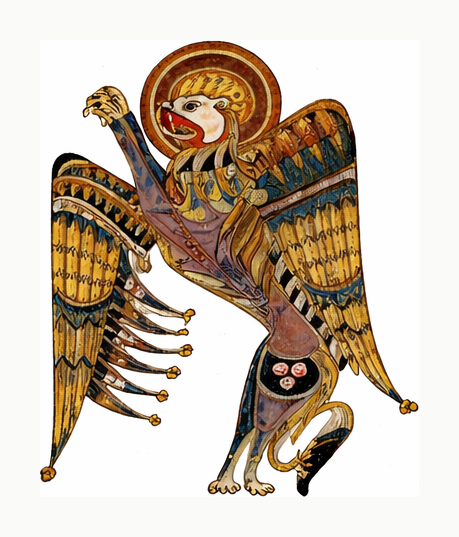
Mark · Lion · Wilderness
The Celtic Wing
Peregrinatio pro Christo
The Meeting Point — between East and West
The Celtic wing is the meeting point. The Christian tradition that reached Ireland did not begin with Patrick; it arrived already shaped by the Egyptian desert. John Cassian carried Anthony and Pachomius's practice west into Gaul in the early fifth century, and from Gaul it pressed further — into Ireland, Iona, Lindisfarne, Skellig — until the desert cell became a coracle and the harsh ascetic rule found its proper geography at the edge of the world.
This is why Patrick and Brendan are venerated in the Eastern Church as readily as in the West. The Insular saints inherit a practice older than the Latin settlement; they carry it across the sixth and seventh centuries with a fidelity that surprises modern readers expecting the standard Romanitas. What is preserved here is not a regional curiosity but a third stream of Christian formation — Mediterranean in origin, Atlantic in expression, and disciplined by the wilderness.
The figures below are the wing's working roster: voyaging saints, women teachers of saints, founders of schools that crossed the sea both directions, hermits and translators. Each study page treats one figure — life, sources, reading list, and a working glossary — in the patient Insular register: vellum and copper, careful Latin and careful Old Irish, the steady labor of scriptorium and sea-road.
Brendan the Navigator is the first of them to have a public home, and the natural first: in him the wing's epigraph stops being a motto and becomes a biography. His introduction carries a second page under it, on what a twentieth-century philologist made of the Navigatio — evidence that this wing's material did not stop being written.
Begin with the page itself
The Reader's Aids — Birds in the Margin
Birds, dogs, gloved hands, and compact marks made to solve a reader's problem. The craft appendix to this wing — and the documented practice that earns the whole library the name Scriptorium.
Begin with the page →Then the road it came by
From the Desert to the Sea
How Egyptian desert monasticism travelled west through Cassian, into Gaul, and finally to the Atlantic edge — where the cell became a coracle and Patrick and Brendan inherited a practice older than the Latin West. The wing's own claim, put to the test.
Follow the road →On the Shelf
9 introductionsThe introductions. One public home per figure: who they are, why they belong here, and a door into study when that study is written.
Patrick
c. 385 – c. 461
Bishop · Missionary · Apostle of Ireland
Romano-British missionary whose two surviving Latin works — the Confessio and the Letter to Coroticus — are the earliest first-person Christian writing from these islands. Foundational for everything that follows.
Introduction not yet writtenColumba
521 – 597
Abbot · Founder of Iona
Of the Cenél Conaill. Carried Irish monasticism to Iona in 563 and founded the school that would send Aidan to Lindisfarne and shape the conversion of Anglo-Saxon Northumbria.
Introduction not yet writtenIta of Killeedy
c. 475 – c. 570
"Foster-mother of the saints"
Muime na náomh — counsellor to Brendan and many others. The female ascetic tradition in early Ireland, often overshadowed by the male voyaging saints she trained.
Introduction not yet writtenFinnian of Clonard
c. 470 – c. 549
Abbot · Teacher of the Twelve Apostles
The Munster master under whom the second wave of Irish monasticism formed. His school at Cluain Eraird gave Ireland Columba, Brendan, Ciarán of Clonmacnoise, and the rest.
Introduction not yet writtenAidan of Lindisfarne
c. 590 – 651
Bishop · Iona missionary to Northumbria
Sent from Iona at the request of Oswald of Bernicia. Founded Lindisfarne in 635. The hinge between Irish and English Christianity in the seventh century.
Introduction not yet writtenCuthbert
c. 634 – 687
Bishop · Hermit of Inner Farne
Anglo-Saxon by birth, Irish by formation. Bridges the Insular synthesis and the Roman settlement after Whitby (664). His Lives — Bede and the anonymous Lindisfarne — define hagiography in the islands.
Introduction not yet writtenHilda of Whitby
614 – 680
Abbess · Convener of the Synod of Whitby
Northumbrian royal turned abbess. Ran the double monastery of Streonæshalch where Cædmon sang the first Christian poem in English. Hosted the synod where the Celtic-Roman question was put.
Introduction not yet writtenEriugena
c. 815 – c. 877
Philosopher · Carolingian translator
An Irishman in the court of Charles the Bald. Translated Pseudo-Dionysius from Greek into Latin and so smuggled the Eastern Logos through a Celtic mind into the Western schools. The Periphyseon is his synthesis.
Introduction not yet writtenReflections
The heart with a named introduction — thoughtfulness that also turns toward the self. More than one reflection may hang from the same figure or craft page.
The Chosen Exile and the Cursed One
Brendan leaves by vow; Suibhne is thrown out by curse. Both end in a wilderness nobody would choose for comfort, both make poems there, and only one of them comes home. This site's argument has so far been carried entirely by the involuntary case. Peregrinatio is the voluntary one — and setting them side by side is the sharpest test of whether the pattern is about exile at all, or about what a person does inside it.
Reflection not yet writtenHow this wing grows
Introduction first — the shelf entry and its public home. Study when a governing question is earned: life and legend, overview, reading list, and how to read, with claim-notes where the facts need them. Reflection afterward — one or many — taking it to heart rather than replacing the introduction.
The craft introduction above (The Reader’s Aids) is attested labour of the Insular page, present before any single saint’s study is complete.