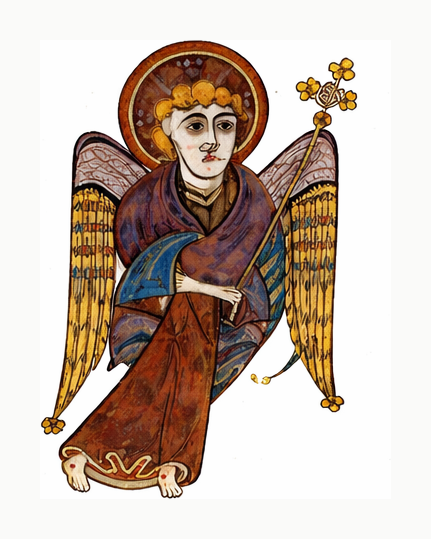
Matthew · Man · Kingship
The Arthurian Wing
Y Mabinogi · Le Morte
The Arthurian wing is the matter of Britain, where Christian imagination meets the older mythic substrate of the islands. The lineage runs through a thousand years of telling: from sixth-century Welsh annals through Geoffrey of Monmouth's Historia in the twelfth century to Chrétien de Troyes's invention of the Grail romance, the Vulgate Cycle, Wolfram von Eschenbach's Parzival, and Malory's Le Morte Darthur in the fifteenth — and from there into Tennyson, Williams, Eliot, White, and the modern recensions.
It is also the wing where Merlin lives — the wild prophet, the cousin-figure to Suibhne and Lailoken, half-mad and half-saint, who must be expelled before he can see. The Arthurian tradition is the only one in this library where Sweeney's exile and the matter of Britain intersect directly. The Grail itself is a Christian symbol — the cup of Joseph of Arimathea, the vessel of the Last Supper — that the romance tradition raises into a vision: the vessel becomes the thing seen.
What sits on this shelf, then, is not a hagiography but a continuous literary genealogy. The figures and texts below are read for the chains of transmission and the differences between recensions — Welsh, Anglo-Norman, French, German, Middle English — and for the symbols that survive across them all: the sword, the wound, the wasteland, the vessel, the king.
The Reading Path
The Matter of Britain
What happens when a kingdom tries to become holy?
This wing now carries a free reading path through Arthurian mythology: thirty-six units in six movements, from the Celtic substrate to the modern returns — with a primary-source library, a motif index (the Anatomy of the Matter), and an annotated map of the scholarship with its controversies included, and a companion chronology and who's-who. A ten-unit Pilgrim's Way serves as initiation; the full path serves the one who wants the whole road. You do not finish it so much as learn how to return.
On the Shelf
10 introductionsIntroductions for figures, texts, and themes. Each opens into the reading path (the study) at the unit where it is studied in full.
Reflections
The heart with a named introduction or a stretch of the reading path — thoughtfulness that also turns toward the self. More than one reflection may hang from the same figure or text.
The Wild Prophet
Suibhne, Lailoken, Myrddin, and Merlin — the same figure pulled across Irish, Welsh, and later Anglo-Norman tellings. The prophet who must be expelled into the wood before he can see, and what the romance tradition does with the Insular original.
Reflection not yet writtenHow this wing grows
Introduction first — the shelf entry. Study here is chiefly the reading path: units that carry text and age, place in the lineage of recensions, editions, and how to read under the lenses of symbol, source, and chivalric ethos. Reflection afterward — one or many — keeping watch with an introduction or a stretch of the path rather than replacing either.
This wing mixes literary genealogy with sacred symbols; the path holds the sustained reading so individual introductions need not rebuild the whole Arthuriad.