The Man of Matthew — Arthurian wing

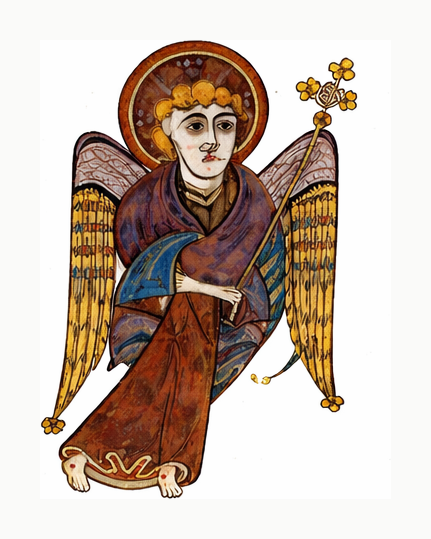
Matthew · Man · Kingship

The Arthurian Wing

Y Mabinogi · Le Morte

The Arthurian wing is the matter of Britain, where Christian imagination meets the older mythic substrate of the islands. The lineage runs through a thousand years of telling: from sixth-century Welsh annals through Geoffrey of Monmouth's Historia in the twelfth century to Chrétien de Troyes's invention of the Grail romance, the Vulgate Cycle, Wolfram von Eschenbach's Parzival, and Malory's Le Morte Darthur in the fifteenth — and from there into Tennyson, Williams, Eliot, White, and the modern recensions.

It is also the wing where Merlin lives — the wild prophet, the cousin-figure to Suibhne and Lailoken, half-mad and half-saint, who must be expelled before he can see. The Arthurian tradition is the only one in this library where Sweeney's exile and the matter of Britain intersect directly. The Grail itself is a Christian symbol — the cup of Joseph of Arimathea, the vessel of the Last Supper — that the romance tradition raises into a vision: the vessel becomes the thing seen.

What sits on this shelf, then, is not a hagiography but a continuous literary genealogy. The figures and texts below are read for the chains of transmission and the differences between recensions — Welsh, Anglo-Norman, French, German, Middle English — and for the symbols that survive across them all: the sword, the wound, the wasteland, the vessel, the king.
On the Shelf

10 studies

Figures, texts, and themes — the Arthurian wing mixes hagiography with literary genealogy. One study page per entry. New entries land here as drafts move to draft-final.

The Welsh Annals & the Mabinogi

c. 9th – 14th centuries

Earliest substratum · Welsh tradition

The earliest written matter: Arthur in the Annales Cambriae and Historia Brittonum, then the Four Branches of the Mabinogi and Culhwch ac Olwen. The Welsh tradition older than the romance, where Arthur is still half-mythic and Myrddin still wild.

Study forthcoming

Geoffrey of Monmouth

c. 1095 – c. 1155

Cleric · Historia Regum Britanniae

The book that made the matter of Britain. Geoffrey claims a Welsh source; what he gives Europe is the full Arthurian frame — Uther, the sword, Merlin, the Round Table, Mordred, Avalon. The romance tradition reads everyone through Geoffrey first.

Study forthcoming

Chrétien de Troyes

fl. c. 1160 – 1190

Champenois poet · Inventor of the Grail romance

The five surviving romances (Erec, Cligès, Lancelot, Yvain, Perceval) reshape Geoffrey's matter into chivalric narrative. Perceval introduces the Grail — and dies unfinished, opening a thousand years of continuations.

Study forthcoming

Wolfram von Eschenbach

c. 1170 – c. 1220

Bavarian poet · Parzival

Takes Chrétien's unfinished Perceval and gives it an ending — and a strange, syncretic theology of the Grail as a stone fallen from heaven. The Parzival is the high point of German chivalric verse, and the source for Wagner's opera.

Study forthcoming

The Vulgate Cycle

c. 1215 – 1235

Anonymous French prose · Lancelot-Grail

The vast prose synthesis: Estoire del Saint Graal, Estoire de Merlin, Lancelot propre, Queste del Saint Graal, Mort Artu. Where Merlin becomes the architect of the kingdom and Galahad replaces Perceval as the destined Grail-knight.

Study forthcoming

Sir Thomas Malory

c. 1415 – 1471

English knight · Le Morte Darthur

Compiled in prison from the French sources. Caxton's 1485 print becomes the canonical English Arthuriad — the source Tennyson reads, the source White reads, the source Eliot reads. Where the Round Table is most fully a Christian fellowship and most fully fails.

Study forthcoming

Merlin

across the tradition

Prophet · Madman · Saint

The wild prophet, cousin to Suibhne and Lailoken. In the Welsh Vita Merlini he flees a battle and lives mad in the wood. In Geoffrey he is the kingdom's architect. In the Vulgate Merlin he is the son of an incubus, baptized to repurpose him for Christ. The figure who must be expelled before he can see.

Study forthcoming

The Grail

across the tradition

Vessel · Vision · Symbol

From Chrétien's mysterious graal to the Eucharistic chalice of the Queste to Wolfram's stone — the symbol that the romance tradition raises into a vision. The cup of the Last Supper, the vessel of Joseph of Arimathea, and the thing that, when seen, ends the seeing.

Study forthcoming

Joseph of Arimathea

Gospel figure · later legend

Burial of Christ · British evangelizer (legend)

In the Gospels: the secret disciple who provides the tomb. In the medieval British tradition: the figure who carries the Grail to Glastonbury and plants the Holy Thorn. The fictive bridge between Gospel history and the matter of Britain.

Study forthcoming

Galahad, Percival, Bors

Vulgate Cycle and after

The three Grail-knights

The trio of the Queste: Galahad the destined virgin, Percival the seeker, Bors the survivor. Each represents a different relation to the vision — fulfillment, longing, and the witness who returns to tell. The shape of every later mystic typology.

Study forthcoming

Wing Essays

Long-form pieces that move across multiple figures in the Arthurian wing.

The Wild Prophet

Suibhne, Lailoken, Myrddin, and Merlin — the same figure pulled across Irish, Welsh, and later Anglo-Norman tellings. The prophet who must be expelled into the wood before he can see, and what the romance tradition does with the Insular original.

Forthcoming

How this wing reads

Each study page in this wing is read against the romance tradition rather than the hagiographic. The four movements adjust accordingly: The Text and Its Age (manuscript history and patronage), Overview (place in the lineage of recensions), Reading List (the editions, the major scholarship, the suggested companion texts), and How to Read (the lenses of symbol, source, and chivalric ethos).

Following these is a Notes and Reflections section — interactive cards on figures, places, and recurring symbols; and the author's essays on the figure or text as they take form.