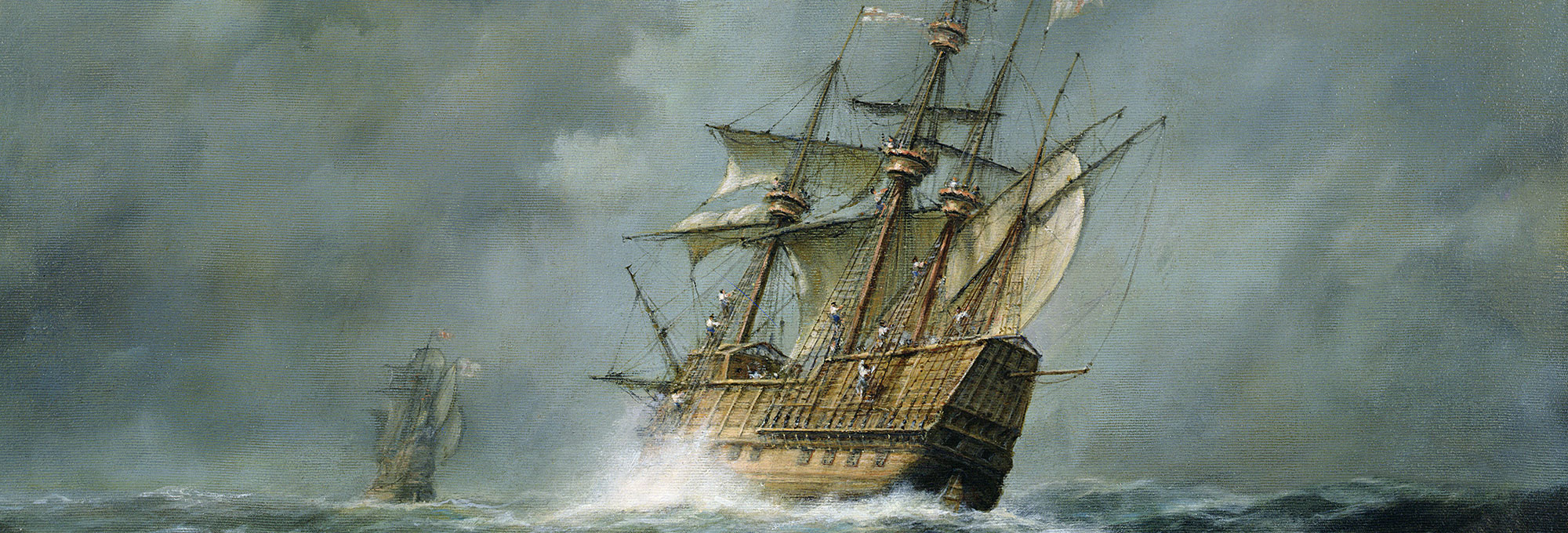
1588: The Spanish Armada in Donegal and the MacSweeneys of Doe
In 1588, the failed Spanish Armada was driven into the North Atlantic on its attempt to return to Spain. Storms and navigational limits scattered ships along Ireland’s coast, including Donegal, producing a brutal collision between shipwreck survival, English counter-measures, and Gaelic politics.
This page focuses on MacSweeney (Mac Suibhne) involvement in three connected Donegal/Ulster episodes:
- Shelter at Doe Castle for Armada survivors.
- Guidance/escort and movement of survivors in southwest Donegal traditions associated with “MacSweeney na Doe”.
- Aid in repairing La Girona at Killybegs, enabling an attempted escape—followed by catastrophe.
Historical context: why Ireland became an Armada graveyard
After engagements in the English Channel, Armada ships attempted to return by sailing north around Scotland and down the Atlantic. Many were already damaged, short on supplies, and then hammered by severe weather. Ireland—especially the west and north—became a disaster zone of wrecks and desperate landfalls.
The English administration in Dublin feared that Spanish landings could spark wider rebellion. Lord Deputy William Fitzwilliam ordered that Spaniards be captured and executed, and that anyone aiding them be punished as a traitor—creating a climate where mercy could be prosecutable. See the “Government preparations” section here:
(For a concise synthesis that also includes Donegal episodes, see History Ireland below.)
The MacSweeneys' Donegal involvement: three documented threads
1) Doe Castle: “refuge to survivors”
Official site history for Doe Castle records that:
“MacSweeney chief Eoghan Óg II gave shelter to survivors of the 1588 Spanish Armada fleet at Doe.”
Source (Heritage Ireland / OPW site page):
A second tourism/historic summary repeats the same claim:
What this firmly supports: Doe Castle tradition is not merely local hearsay; it is presented as part of the castle’s public historical interpretation, naming a specific MacSweeney chief.
What it does not specify (and what you can treat as open for research or careful creative reconstruction):
- Which ship’s survivors were sheltered at Doe
- How many survivors
- How long they remained
- Their ultimate fate (escape, capture, death, assimilation)
2) Southwest Donegal: survivors of La Duquesa Santa Ana and “MacSweeney na Doe”
A Donegal local-history commemoration account of the wreck of La Duquesa Santa Ana at the Loughros Peninsula describes survivors moving under the protection/escort of “McSweeny Na Doe”:
A modern heritage-week program description similarly anchors the wreck and its survivor-walk narrative to Loughros Peninsula (September 1588):
Why this matters: Even allowing for the interpretive nature of commemoration writing, this thread supports a broader Donegal pattern where MacSweeney authority is remembered as active in shepherding survivors across difficult terrain—consistent with the “refuge at Doe” tradition.
3) Killybegs and La Girona: repair assistance from MacSweeney Bannagh
A widely cited Donegal episode involves the Spanish galleass La Girona, which anchored at Killybegs with damage and took on survivors from other wrecks. Multiple sources state that MacSweeney Bannagh aided the Spanish and supported repairs before La Girona attempted to reach Scotland.
- History Ireland (Donegal episode + repair + sailing attempt):
- Wikipedia summary (Killybegs anchorage; “assistance of an Irish chieftain, MacSweeney Bannagh”; departure 25 Oct; wreck 26 Oct):
- A Northern Ireland heritage editorial also repeats the repair-assistance claim and connects it to museum commemoration:
Outcome: La Girona sailed (25 Oct 1588) but wrecked the next night off the Antrim coast with catastrophic loss of life (often summarized as roughly 1,300 aboard with only a handful surviving). See:
A compact timeline (Donegal / Ulster emphasis)
- Aug–Oct 1588: Armada ships scattered onto Irish coasts; survivors come ashore across Ulster/Connacht/Munster.
- Aug 1588 onward: Fitzwilliam’s security policy: capture and summary execution of Spaniards; severe punishment for helpers.
- Sept 1588 (SW Donegal): La Duquesa Santa Ana wrecked at Loughros Peninsula; survivors remembered moving with “McSweeny Na Doe”.
- 1588 (Doe Castle, Sheephaven): Doe Castle tradition: Eoghan Óg II shelters survivors.
- Late Oct 1588 (Killybegs → Antrim): La Girona repaired with help of MacSweeney Bannagh; departs; wrecks off Antrim (26 Oct 1588).
Why would the MacSweeneys help? (Interpretive notes, grounded in the sources)
The sources above generally describe assistance more than they explain motives. Still, the political logic of the moment makes several motives plausible:
-
Defiance of Crown authority / assertion of Gaelic jurisdiction: Fitzwilliam’s policy criminalized aid; sheltering survivors can be read as a practical declaration that the castle’s law was not Dublin’s law.
-
Strategic leverage: Spanish officers and survivors could represent bargaining value—information, future alliance possibilities, or simply a way to signal resistance during a period of tightening English control.
-
Hospitality norms and human sympathy: Shipwreck survival is a powerful moral claim; Donegal traditions preserve memories of assistance even amid wider slaughter—suggesting that local ethics and politics sometimes overrode terror policy.
What resulted from it?
Immediate consequences
- For survivors: outcomes ranged from escape attempts, to capture and execution, to absorption into local networks—varying drastically by location and who offered protection.
- For helpers: the English policy posture meant that helping Spaniards could expose local leaders to lethal legal risk and reprisal (even if enforcement varied by region).
Longer legacy
- Place-memory: Doe Castle’s public interpretation explicitly carries the Armada-shelter episode as part of MacSweeney history.
- Material commemoration: La Girona is commemorated in museum displays and heritage storytelling; it remains one of the most famous Armada wrecks in Ulster memory.
- Narrative power for a Sweeney/MacSweeney site: this is a “small hinge” where clan story intersects with European war—refuge, peril, and the ethics of shelter under tyranny.
Research leads for deeper documentation
If you want to push beyond “tradition + synthesis” into primary documentation, pursue:
-
On-site Doe Castle panels / OPW interpretive bibliography The web page is brief; the on-site display panels may cite specific archival references.
-
National Folklore Collection / Dúchas and Donegal oral-history items Useful for mapping how survivor stories were preserved locally.
-
Spanish survivor accounts (e.g., Captain Francisco de Cuéllar) and modern joint publications Recent Irish/Spanish publication work highlights Cuéllar as a key witness for the northwest survivor experience:
-
State Papers / English administrative correspondence (1588–1589) Search for references to sheltering, harboring, or moving Spaniards in Donegal (often appears in proclamations, reports, and prosecutions).
Suggested images (Creative Commons / easy to attribute)
If you want a thematic hero image for this page, these are strong and usually straightforward to reuse with attribution and license compliance:
- Doe Castle, Donegal (photo; Wikimedia Commons file page includes author + license):
- Doe Castle (additional angle):
- Loughros Peninsula category (choose a landscape photo for the “survivor march” mood):


Tip: copy the attribution line from the Wikimedia file page (“Author / License / Source”) into your site caption or credits section.
Further reading (curated)
- Doe Castle (Heritage Ireland / OPW): https://heritageireland.ie/places-to-visit/doe-castle/
- History Ireland overview (includes Donegal episodes + La Girona repair): https://historyireland.com/spanish-armada-wrecks-on-the-irish-coast/
- Spanish Armada in Ireland (Fitzwilliam policy context): https://en.wikipedia.org/wiki/Spanish_Armada_in_Ireland
- La Girona (Killybegs repair + Antrim wreck): https://en.wikipedia.org/wiki/Girona_(ship)
- Donegal commemoration of Duquesa Santa Ana survivors + “McSweeny Na Doe”: https://www.donegallive.ie/news/donegal-life/329238/430-years-on-locals-in-south-west-donegal-to-remember-the-survivors-of-spanish-armada-shipwreck.html
- Irish/Spanish joint publication announcement on Captain Cuéllar: https://www.gov.ie/en/department-of-housing-local-government-and-heritage/press-releases/new-irishspanish-joint-publication-reveals-the-fascinating-story-of-captain-cu%C3%A9llar-1588-spanish-armada-shipwreck-survivor/