The Rule
The rule Moling gave Suibhne at Teach Moling — range by day, return at evening, and the record kept — and what it asks of a reader who no longer lives in a monastery.
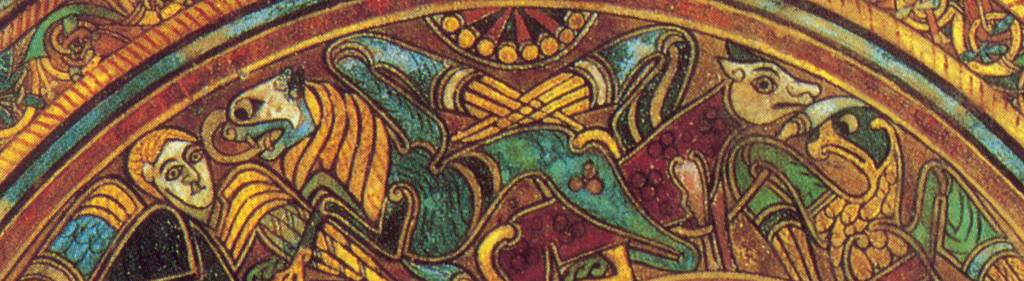
"I bind you, that however much of Ireland you may travel each day, you will come to me each evening so that I may write your history."
A rule, in the monastic sense, is not a list of prohibitions. It is a shape given to a day — what is done, when, and in whose hearing — held steadily enough that a life takes its form. The word survives in ordinary speech as the opposite of freedom, which is nearly the reverse of what it meant to the houses that kept one.
This site did not have to go looking for one. The tale it is built on ends with a rule, given by name, to a man who had spent seven years in the trees — and the rule is the reason the tale exists at all.
I · What Moling asked
The Binding
The flight runs out at Teach Moling. The saint is reading the psalter of Kevin to his students; the madman comes to the brink of the well and eats watercress; and their first exchange — before anything is settled between them — is about the hours of prayer (§§ 74–75).
What Moling then does is the whole of it. He does not cure Suibhne, and he does not cage him. He binds him with a promise, and orders him fed (§§ 76–77). Four things are asked, and only four.
-
i
The range
Suibhne goes where he likes each day — Innis Bo Finne, Eas Ruaidh, Sliabh Mis, Benn Boirche.
-
ii
The return
But he attends at vespers each night at Teach Moling. The hour is fixed; the day is not.
-
iii
The record
The reason given for the return is the writing: "so that I may write your history."
-
iv
The meal
Moling orders a collation kept for him at that hour — the milk left in the print of a heel.
Read together they are a prayer rule of the plainest kind: a fixed hour, a fixed place, an appointed writing, and a meal kept back for whoever keeps it. What they are not is a confinement. Suibhne ranges the whole island by day — the tale names the places — and the rule touches only the evening. The freedom is not taken away. It is given a return.
II · What it cost him
The Door-Post
He keeps it for a year. Every evening, from wherever in Ireland he has been, he comes back for vespers — and he never goes in. He is fed in the milking yard rather than at table, out of the print of a heel in the cowdung, and he comes to it "cautiously and carefully." The rule is kept in full and the threshold is never crossed.
It is worth reading the end of the tale with that in view. When the spear finally comes it comes in the milking yard, at the meal (§§ 78–83). And when he dies, he dies at the door: he sets his shoulders against the door-post of the church, sighs, and his spirit goes (§§ 84–87). A year of obedience, and the last thing he touches is the frame of a door he never walked through.
That is the honest half of this movement, and the reason the hub's third motion is a call rather than a demand. The rule can be kept perfectly by someone who is still outside. Whether the keeping was enough is not a question the tale answers, and it is not one this page will answer either; it is the ground the identity essay is written on.
III · Where such a rule comes from
The Day Behind It
Moling's binding is not an invention of the moment. It is a miniature of the thing his house already ran on: the horarium, the day cut into fixed hours of prayer with reading and manual labour set between them. Benedict wrote that architecture down in the West around 530, and it is the clearest surviving statement of it — fixed hours, appointed reading, the labour of the hands, all treated as one fabric rather than three duties.
It is worth seeing how much of the day the hours actually claimed.
- Matins · Vigils c. 2 a.m. The night office, kept in the dark.
- Lauds c. 5 a.m. Morning prayer, at first light.
- Prime c. 6 a.m. The first hour.
- Terce c. 9 a.m. The third hour. The day’s work generally began after it.
- Sext c. noon The sixth hour.
- None c. 3 p.m. The ninth hour.
- Vespers c. 5 p.m. Evening prayer — the hour Moling fixed.
- Compline c. 7 p.m. The day closed, and the night silence begun.
The clock times are modern approximations, given only so the shape is visible. The offices were reckoned against sunrise and sunset and moved through the year, and an Irish house kept its own count.
Set beside that, Moling's rule is very small. He does not ask Suibhne for the night office, or for the hours between. He asks for one — and he asks for the one the day turns on. Vespers is the seventh of eight, the hinge where the light goes and the community gathers before the last silence. A man who cannot bear a roof is given the single hour at which a house is most itself, and the rest of the clock is left to him. That reading is this page's rather than the tale's; what the tale supplies is the hour.
The rest of the horarium's architecture is worth naming because Moling's fourth part — the record — sits inside it. Benedict's chapter 48 does not command transcription and never names a scriptorium; what it commands is reading, two hours of it daily, with a whole book assigned to each monk through Lent. Before print, a house ordered that way needs copies, and needing copies means needing hands. The demand for the written word is stated; the writing follows from it. Two centuries earlier Pachomius had already made the same demand at the door: his Egyptian communities expected every monk to read, and required those who could not to learn.
The rule could also bend for the work. Cassiodorus, founding the Vivarium in Calabria around 540, exempted his best scribes from some of their prayer obligations so that they could stay longer at the desk, and equipped the room with a sundial, a water-clock, and a lamp fed from its own reservoir so the work could outlast the daylight. That is a rule adjusting itself to protect an office it judged to be prayer by other means — the same judgment Moling makes when he lets a man keep the woods on condition that the evening is kept.
But Benedict is corroboration here, not source. An Irish house of the seventh century was not keeping Benedict's rule, and the practice it was keeping came by a different road — out of the Egyptian desert, through Cassian and Gaul, to the Atlantic edge, where the cell became a coracle. That road is the study under this page.
The study under this page · Celtic wing
From the Desert to the Sea
How Egyptian desert monasticism travelled west through Cassian, into Gaul, and finally to the Atlantic edge — and what the Irish rules made of it when it arrived.
Read the study →IV · What it asks of a reader
A Rule to Keep
Outline only; the four parts translated, not yet written outNobody reading this has an abbot, and nobody has a milking yard. But the four parts survive translation, and translating them is the whole of what the keystone essay, Return of the Scriptorium, is being written to do. The shape it takes here:
-
i · The range
To be written.
-
ii · The return
To be written.
-
iii · The record
To be written.
-
iv · The meal
To be written.
Related
- The Binding and the Milk — the scene this page is read from — O'Keeffe's translation, §§ 76–77
- From the Desert to the Sea — the study under this page — Egyptian practice, Cassian, and the Irish rules that inherited it
- Scriptorium — the second movement — the room where the record is kept
- The Bard's Dilemma — the office, and the passage from feather to quill
- Buile Suibhne — The Source — the whole tale in the 1913 translation, cited by section
References
Where the rule above is read from, and where this page is corroborating rather than claiming.
- J. G. O'Keeffe, ed. and trans., Buile Suibhne (Irish Texts Society, 1913), §§ 74–87 — the arrival at Teach Moling, the binding, the collation, and the death at the door-post. Quoted from the text set on this site, which follows O'Keeffe's printed edition. Section numbers are his.
- Benedict of Nursia, Regula Benedicti (c. 530), esp. chh. 8–20, 48 — the horarium: fixed hours of prayer, appointed reading, and the labour of the hands as one architecture. Read here as corroboration rather than source. The rule this page describes is given inside Buile Suibhne; Benedict shows the same architecture standing elsewhere, in a house that wrote its practice down.
- The canonical hours as set out in the Regula Benedicti chh. 8–20, with the horarium reconstructed in the standard accounts of monastic daily life. The clock times on this page are conventional modern approximations. The offices were reckoned against sunrise and sunset and shifted through the year; the sequence is firm, the hours are not. Reading vespers as "the hour the day turns on" is this page's gloss, not a claim of the sources.
- Pachomius of Egypt (c. 292–346) — the first cenobitic rule, which expected monks to read and required those who could not to learn. Cited for the demand for literacy at the door of the community, which is older than any Western rule and reaches this page by the desert road rather than through Benedict.
- Cassiodorus, Institutiones divinarum et saecularium litterarum (c. 560), and the accounts of the Vivarium's sundial, water-clock, and self-feeding lamp. The exemption of skilled scribes from some prayer obligations is reported of the Vivarium specifically and should not be generalised into a norm of Western monasticism.
- The Irish monastic rules — Columbanus, Ailbe, Comgall, and the Céli Dé material — as the comparison set for what an Irish house asked of its members. Named here as the reading list for the study under this page. None of it is quoted or characterised until it has been read against an edition.
- Isaiah 40:31 (KJV) — the epigraph of the hub this page serves, and the name of the station: mounting up with wings as eagles.