Watchfulness
Nepsis is sober attention at the door of the heart: seeing a thought arrive before consenting to it.
Eastern Wing · Major Study
c. 1754 – 1819
Mount Athos · Kollyvades · Philokalia · Slavonic transmission
In the late eighteenth century, monks on Athos and in the Slavonic world recovered a library whose real subject was attention: how the heart is guarded, the Jesus Prayer becomes constant, and the human person is opened to divine light. The Greek Philokalia and Paisius’s Dobrotolubiye did not create hesychasm. They made a living inheritance portable again.
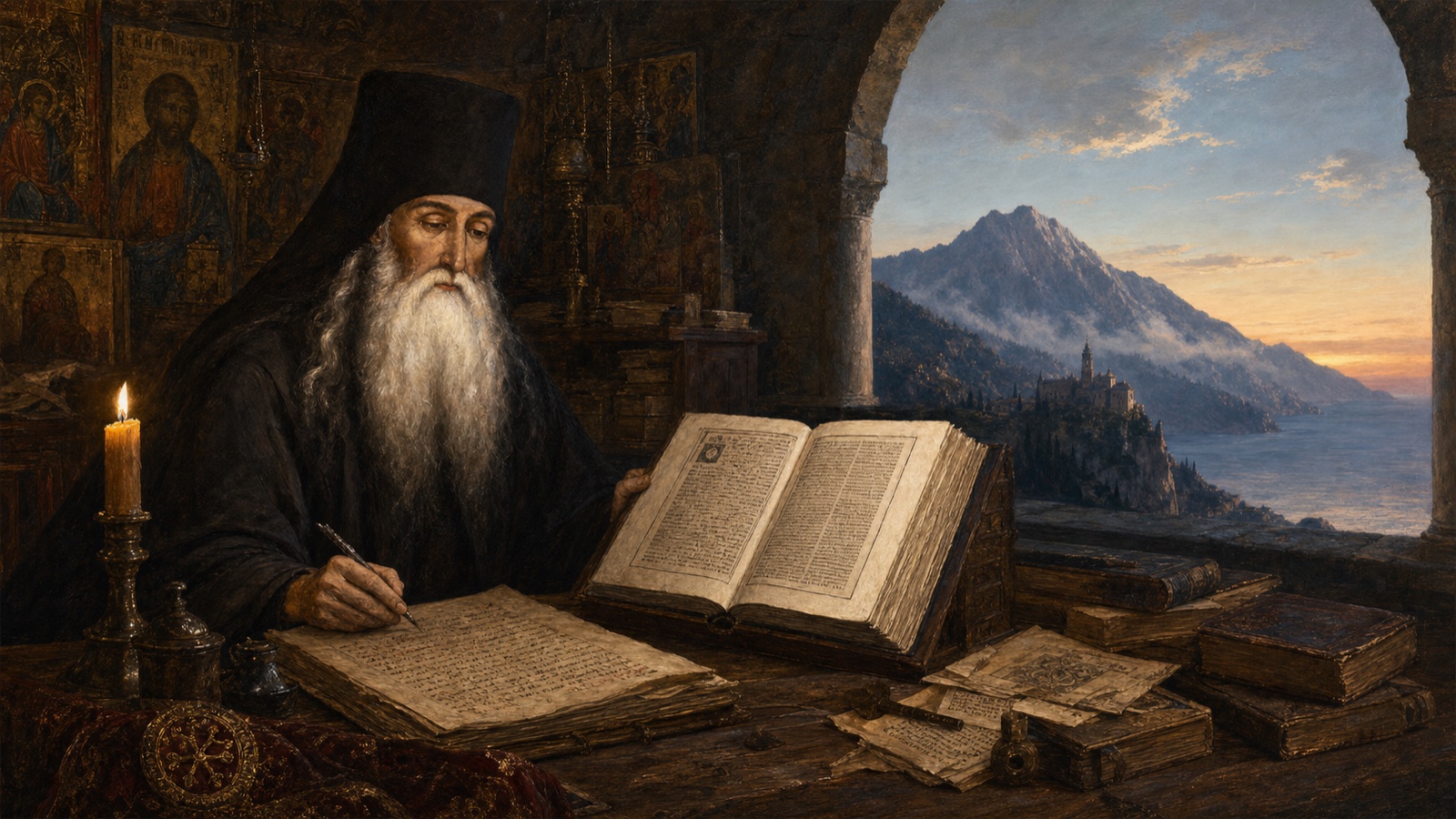
Nepsis is sober attention at the door of the heart: seeing a thought arrive before consenting to it.
A short invocation gathered into the breath and heart, never magic and never severed from sacramental life.
“Love of the beautiful”: an anthology from the fourth to the fifteenth centuries, arranged for purification and prayer.
God is unknowable in essence yet truly participated in his energies; Tabor names a communion, not a metaphor.
The life of a movement
The revival had no single founder and no clean starting gun. It joined a liturgical dispute, a manuscript rescue, a publishing venture, and several networks of spiritual fatherhood.
St Gregory Palamas defends the Athonite hesychasts: God remains unknowable in essence while truly communicating himself in his uncreated energies. The light of Tabor is not a created symbol.
Vatopedi becomes a meeting place for classical learning, Enlightenment currents, and monastic tradition. Eugenios Voulgaris’s tenure makes the century’s tension visible.
A dispute over memorial services expands into a program of patristic return, frequent Communion, liturgical exactness, and prayer of the heart.
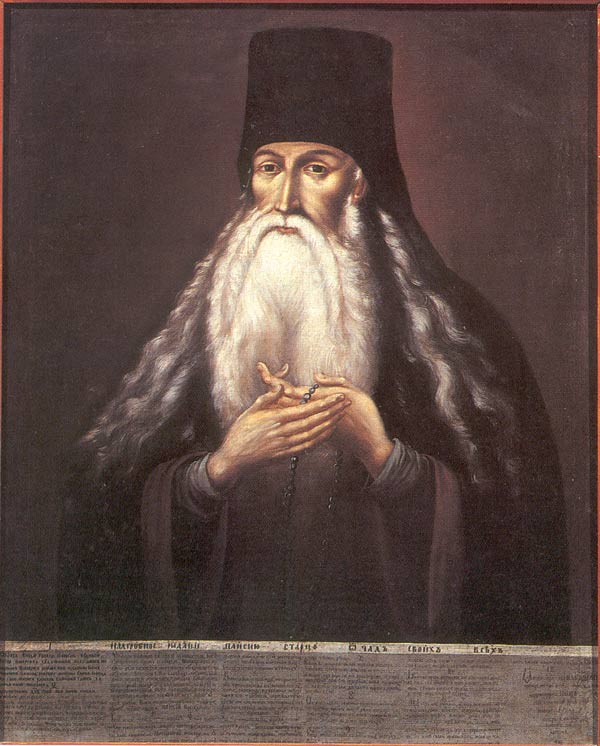
After years on Athos, Paisius carries Greek manuscripts into Moldavia and forms a multilingual brotherhood around correction, translation, obedience, and inner prayer.
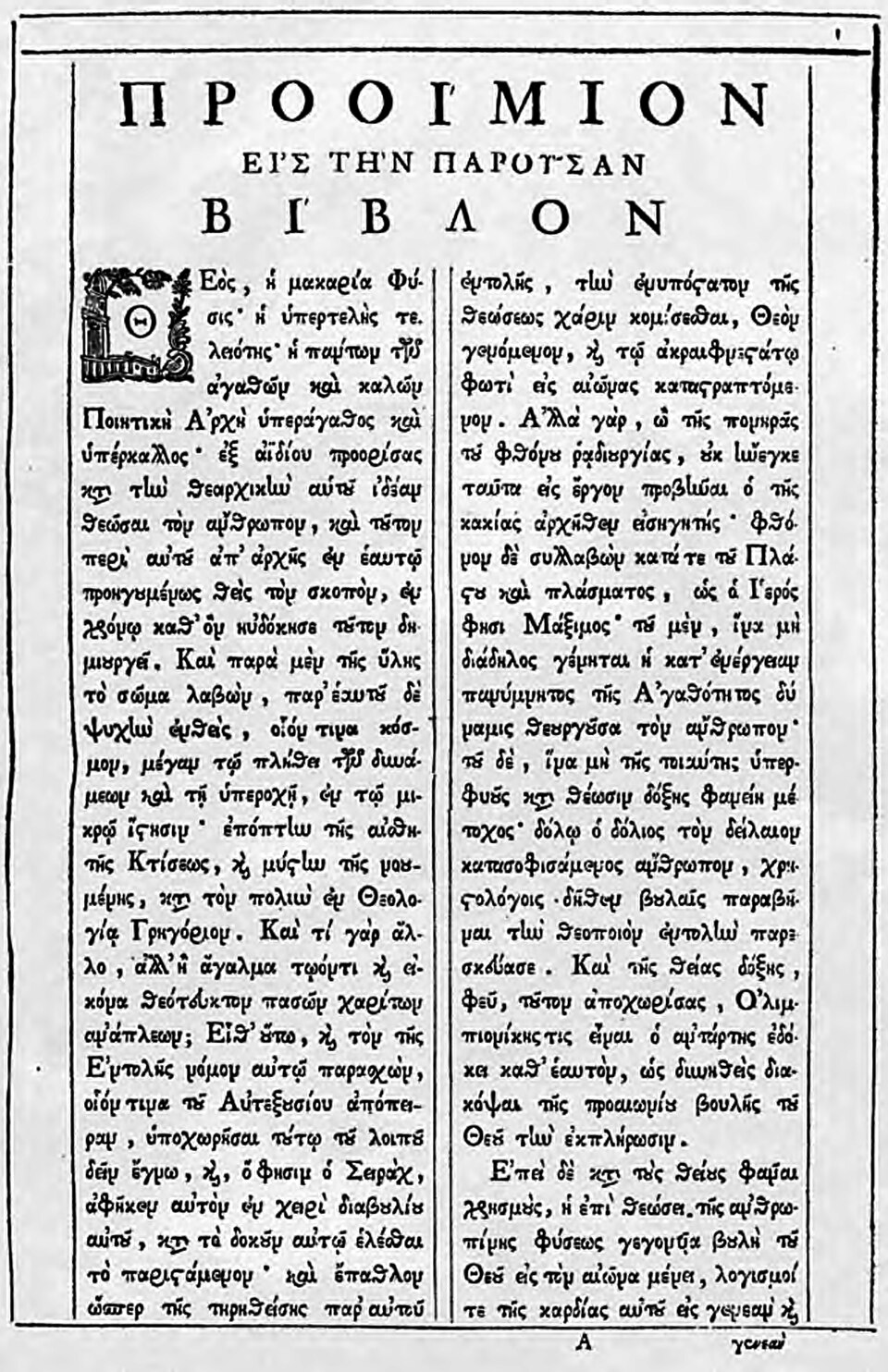
St Makarios of Corinth and St Nikodemos the Hagiorite bring a vast anthology of neptic writing to print in Venice, financed by John Mavrogordato.
Paisius’s Slavonic collection is printed in Moscow. It is a parallel labor with its own manuscript history, not merely a translation of the Venetian volume.
Constantinople confirms that frequent reception, with preparation, belongs to the Church’s tradition rather than to innovation.
Paisian disciples, Optina elders, Sarov, and eventually The Way of a Pilgrim carry the neptic vocabulary into Russian religious life and beyond the monastery.
The anthology’s inner unity
The Philokalia gathers writers separated by language, century, and controversy, yet their practical sequence is recognizable: guard the senses, discern thoughts, remember God, invoke the name of Jesus, and let prayer descend from speech into the heart. Its subject is not private serenity. It is the healing and transfiguration of the whole person in Christ.
The fourteenth-century hesychast controversy supplies the theological guardrail. St Gregory Palamas refused both the claim that God can be comprehended and the claim that grace must be created. God’s essence remains beyond participation; his uncreated energies are God truly present and given. The light encountered in purified prayer is therefore neither imagination nor possession, but communion received as gift.
“The intellect is purified, illumined, and made perfect.”
The program announced on the title page of the 1782 Philokalia
The Fathers were republished because their counsel could still be obeyed, not because the eighteenth century wanted a museum of mystical prose.
The Jesus Prayer belongs with confession, Communion, obedience, fasting, mercy, and a guide capable of recognizing delusion.
Venice 1782 and Moscow 1793 meet in a shared inheritance, but Paisius’s translations grew from years of separate manuscript labor.
Nikodemos addresses all Christians while still assuming that advanced ascetic counsel requires formation, patience, and discernment.
A constellation, not a chain
Initiator of the Philokalia’s manuscript gathering and advocate of frequent Communion.
Editor, harmonizer, and tireless publisher: the Philokalia, Unseen Warfare, the Rudder, and editions of Symeon and Palamas.
Translator and spiritual father whose Athonite and Moldavian brotherhoods carried the neptic fathers into Slavonic monastic life.
Kollyvades teacher and controversialist who joined liturgical renewal to education and resistance to Enlightenment reduction.
Athonite-formed itinerant preacher and neomartyr whose mission joined sacramental renewal to popular teaching.
The earlier theologian whose account of prayer, the body, and uncreated light gave the revival its doctrinal grammar.
Text, image, and passage
A manuscript tradition becomes a movement through people who copy, compare, translate, print, finance, carry, and teach. The material history of the page belongs inside the spiritual history.
The same spiritual weather
St Seraphim’s lifetime falls inside this wider renewal. His forest cell was called “Mount Athos”; his counsel gathers around prayer, watchfulness, the Holy Spirit, and a light the body itself can bear. A copy of the Dobrotolubiye reached Sarov through the monk Nazar. None of this proves a personal relationship with the Kollyvades editors, and none is needed.
The honest claim is contemporaneity and shared grammar. Athos, Moldavia, Sarov, and later Optina are separate places in which the same patristic vocabulary becomes newly audible.
A humane reading order
Read “The inner unity of the Philokalia” before opening a volume. It explains why texts from many centuries form one practical anthology.
Hesychios, Philotheos of Sinai, and selected chapters on watchfulness make a sound doorway. Read slowly; the book is a rule of attention, not a spiritual encyclopedia.
Study the 1782 Venice edition beside Paisius’s life and translation work. Their convergence matters, but so do their different communities and textual histories.
Read the Motovilov conversation after the anthology. The acquisition of the Spirit and the light in the snow show the tradition becoming a life rather than remaining a shelf.
How to study
Keep three strands distinct in your notes: the Kollyvades’ liturgical program, the Greek anthology as an editorial event, and Paisius’s translation communities. Then mark where they converge: frequent Communion, patristic return, watchfulness, and prayer of the heart.
Read fewer chapters than you think you should. Copy one sentence by hand, test its vocabulary against Scripture and the liturgy, and resist collecting counsels that you have not yet lived. The Philokalia’s proper reader is not the one who finishes fastest, but the one whose attention becomes less divided.
The study distinguishes the eighteenth-century Greek publishing project from Paisius’s parallel Slavonic transmission. Public-domain visual sources are retained below the generated editorial image.