Solitude to welcome
The forest, silence, and reclusion prepare an elder able to receive hundreds without losing the heart’s stillness.
Eastern Wing · Major Study
1754 – 1833
Hieromonk · Wonderworker · Elder of the Russian desert
The hermit of Sarov stood on a rock through a thousand nights, opened his door to the world, and taught that the aim of Christian life is not the accumulation of religious works but the acquisition of the Holy Spirit. His life moves from enclosure to welcome, from the darkness of vigil to a face shining in winter light.
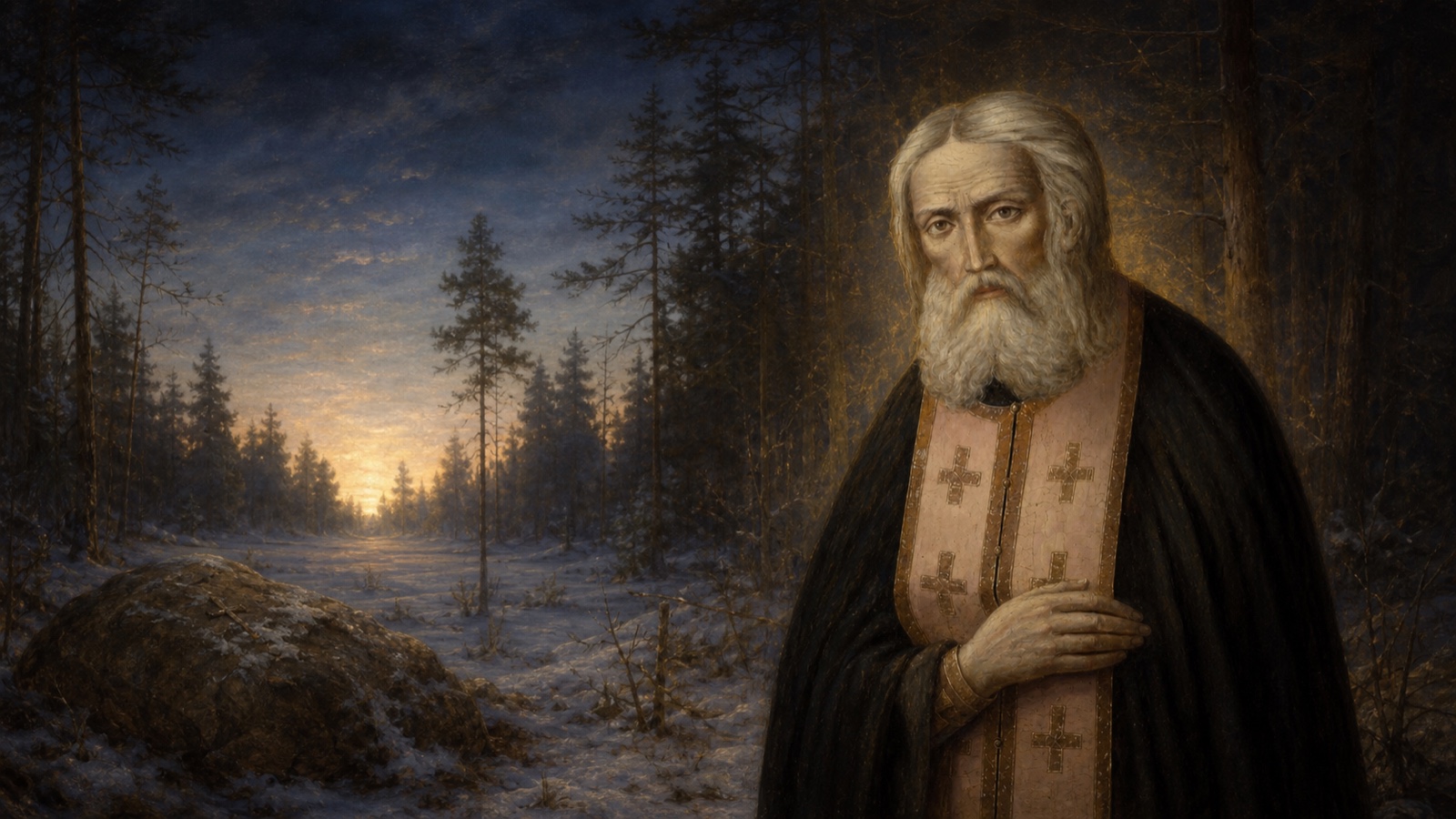
Why the thousand nights are not merely an ascetic feat, but an argument about vigilance, repentance, delay, and the Last Day.
The forest, silence, and reclusion prepare an elder able to receive hundreds without losing the heart’s stillness.
Ascetic works are means; the Holy Spirit is the end and giver, making Christian life more than moral exertion.
The rock gathers repentance, eschatological vigilance, and the desert’s unceasing cry into one remembered act.
The Paschal greeting names each visitor by the Resurrection and turns private attainment into peace for others.
From Kursk to Diveyevo
Seraphim’s Life is both chronology and icon. Dates, ordinations, and institutions stand beside visions, healings, the bear, the rock, and the light. The forms of evidence should be distinguished without tearing apart the Church’s received memory of the saint.
Born into a merchant family and named for Prochorus the deacon. The received Life places signs of protection by the Mother of God around his childhood.
After pilgrimage and counsel at Kiev, Prokhor enters Sarov under Abbot Pachomius and Elder Joseph.
He is tonsured with the name Seraphim, ordained hierodeacon, and then hieromonk. His name means one of the burning ones.
He withdraws to a cell he calls “Mount Athos,” ordering solitude around Scripture, labor, fasting, and the Jesus Prayer.
The Life remembers a thousand days and nights of prayer on a granite boulder, repeating the publican’s cry: “God, be merciful to me a sinner.”
After a near-fatal beating and his forgiveness of the robbers, Seraphim passes through intensified silence and enclosure.
A vision of the Mother of God ends the strict reclusion. The hermit becomes a starets who receives ordinary people with the Paschal greeting.
In a winter clearing, Seraphim teaches that the aim of Christian life is the acquisition of the Holy Spirit; Motovilov reports light, warmth, fragrance, and peace.
He is found kneeling before the Umilenie icon of the Mother of God, the “Joy of All Joys.”
Glorified at Sarov in 1903, his relics are later confiscated, rediscovered in 1991, and translated to Diveyevo.
The conversation’s center
In the conversation recorded by Nicholas Motovilov, Seraphim distinguishes the means of Christian life from its aim. Prayer, fasting, vigil, and almsgiving are genuine goods, but they are not trophies and they do not purchase God. They are commerce only by analogy: practices through which a person learns to receive, retain, and answer grace.
“Acquire the Spirit of Peace, and a thousand souls around you will be saved.”
St Seraphim of Sarov · received saying
Prayer, fasting, vigil, and almsgiving are not the final object. They are forms of exchange through which the heart becomes capable of receiving and keeping grace.
“Acquire the Spirit of Peace” turns sanctity outward: the healed person becomes shelter and possibility for those nearby.
Seraphim inherits the desert conviction that thoughts are discerned at the heart’s door and gathered into remembrance of God.
“Christ is risen, my joy” is not cheerfulness laid over suffering. It is the Resurrection used as the true name of every person received.
A fixed post in the darkness
The Life places Seraphim on a granite boulder for a thousand days and nights, repeating the publican’s prayer: “God, be merciful to me a sinner.” The scene is usually filed under feats of endurance. Yet its number, setting, posture, and prayer form a denser grammar: a thousand, the biblical measure of divine time; night, the hour of vigil; an elevated post; and repentance, the reason St Peter gives for the apparent delay of the Day of the Lord.
The new Reflection follows that grammar through the Psalms, the watchman prophets, the thief sayings, the trumpet, the desert fathers, and the Philokalia. Its thesis is plain: eschatology correctly understood does not produce calculation. It produces vigil.
“A thousand nights is a quantity of oil.” Read the full argument.
The day star in a heart
In November 1831, Seraphim and Motovilov speak in a winter clearing. The teaching becomes spectacle: Motovilov reports that the elder’s face shone more brightly than the sun while both men stood in warmth, fragrance, and deep peace. Orthodox readers hear the light of Tabor, defended by St Gregory Palamas as uncreated energy—God truly communicated without the divine essence becoming an object that can be contained.
The scene does not make light an achievement or Seraphim a religious performer. He asks Motovilov what he feels, directs attention to the Spirit already given, and frames the disclosure as reassurance. The sign is relational: one face made luminous so another person can recognize what grace is doing.
A shared Orthodox weather
Seraphim’s life overlaps a renewal with no single capital. The Kollyvades recover frequent Communion and patristic practice on Athos; Makarios and Nikodemos publish the Greek Philokalia in Venice in 1782; Paisius’s independent translation brotherhood brings a Slavonic Dobrotolubiye to Moscow in 1793. A copy reaches Sarov through the monk Nazar.
There is no documented personal link between Seraphim and the Greek editors. The responsible claim is climate, not correspondence. His “Mount Athos” hermitage, hand-on-heart posture, watchfulness, and Motovilov’s light speak the same language without requiring an invented chain.
The study becomes a rule
These dedicated prayer pages use large type and a phone-friendly focus mode. Each keeps its own sources and pastoral cautions.
Further study and reflection
Begin with the received chronological arc: Kursk, Sarov, forest, rock, reclusion, eldership, and repose. Mark which episodes are hagiographic testimony.
Then read “On the Acquisition of the Holy Spirit” in full. Attend to the movement from means and end to an embodied disclosure in the snow.
Read one short neptic text from the Philokalia and the study of the eighteenth-century revival. This keeps Seraphim inside the tradition he embodies.
Use the short rule for a week, or one decade of the Rule of the Theotokos each day, then return to the Life with practice in the body.
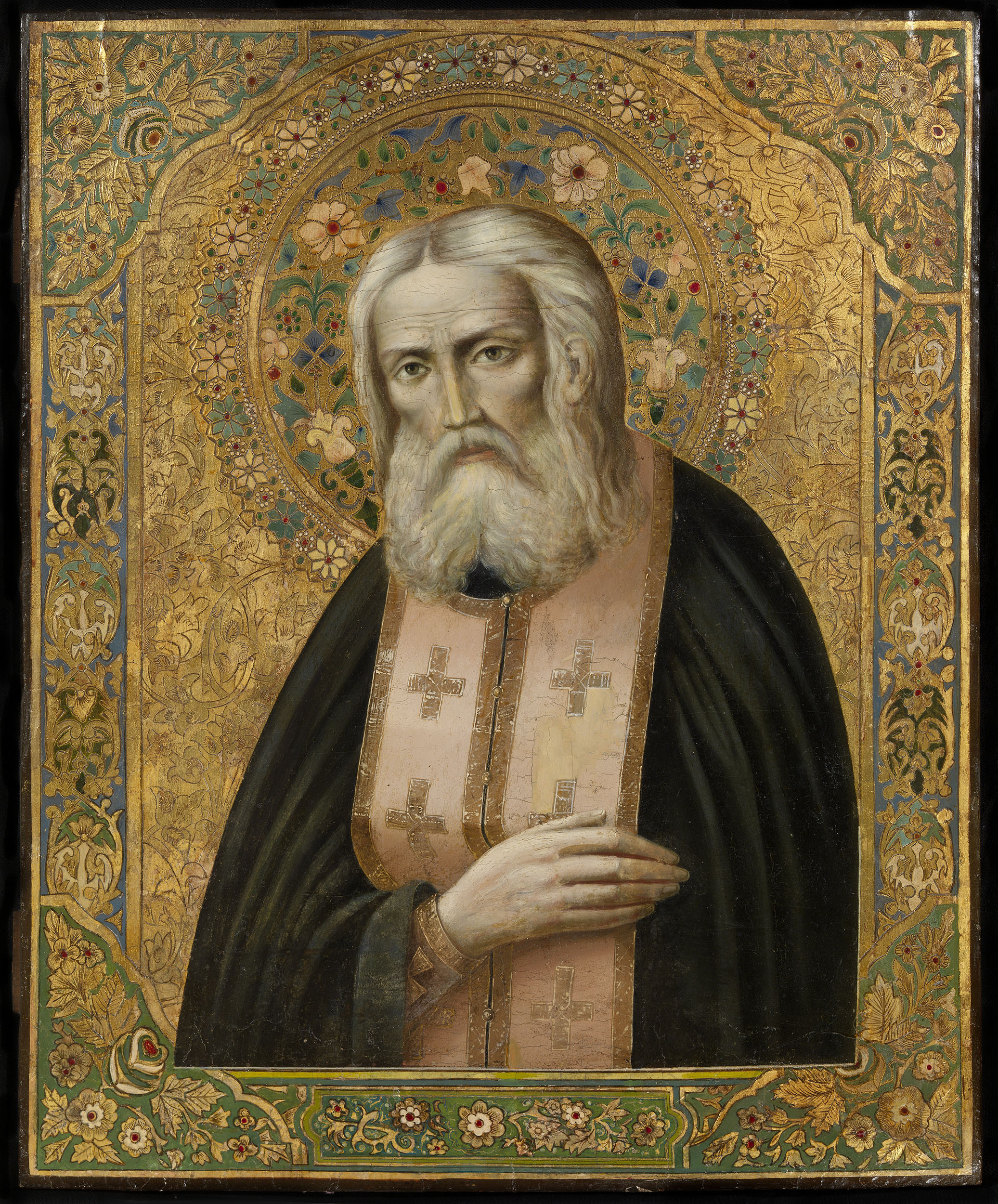
Chronology and historical transmission are distinguished from the Life’s hagiographic testimony. The public-domain source icon is retained beside the generated editorial image.