Christology
Every authentic Marian title says something first about who Christ is and then about what redeemed humanity may become in him.
Eastern Wing · Major Study
First century · Biblical witness and living tradition
Mother of God · Ever-Virgin Mary · Image of the Church
Orthodox devotion to Mary begins and ends with Jesus Christ. The title Theotokos— “she who gave birth to God”—confesses that the son she bore is not a human person later joined to God, but the one eternal Word made flesh. From that Christological center unfold her biblical titles, liturgical feasts, icons, hymns, intercession, and place as the first and fullest human answer to divine grace.
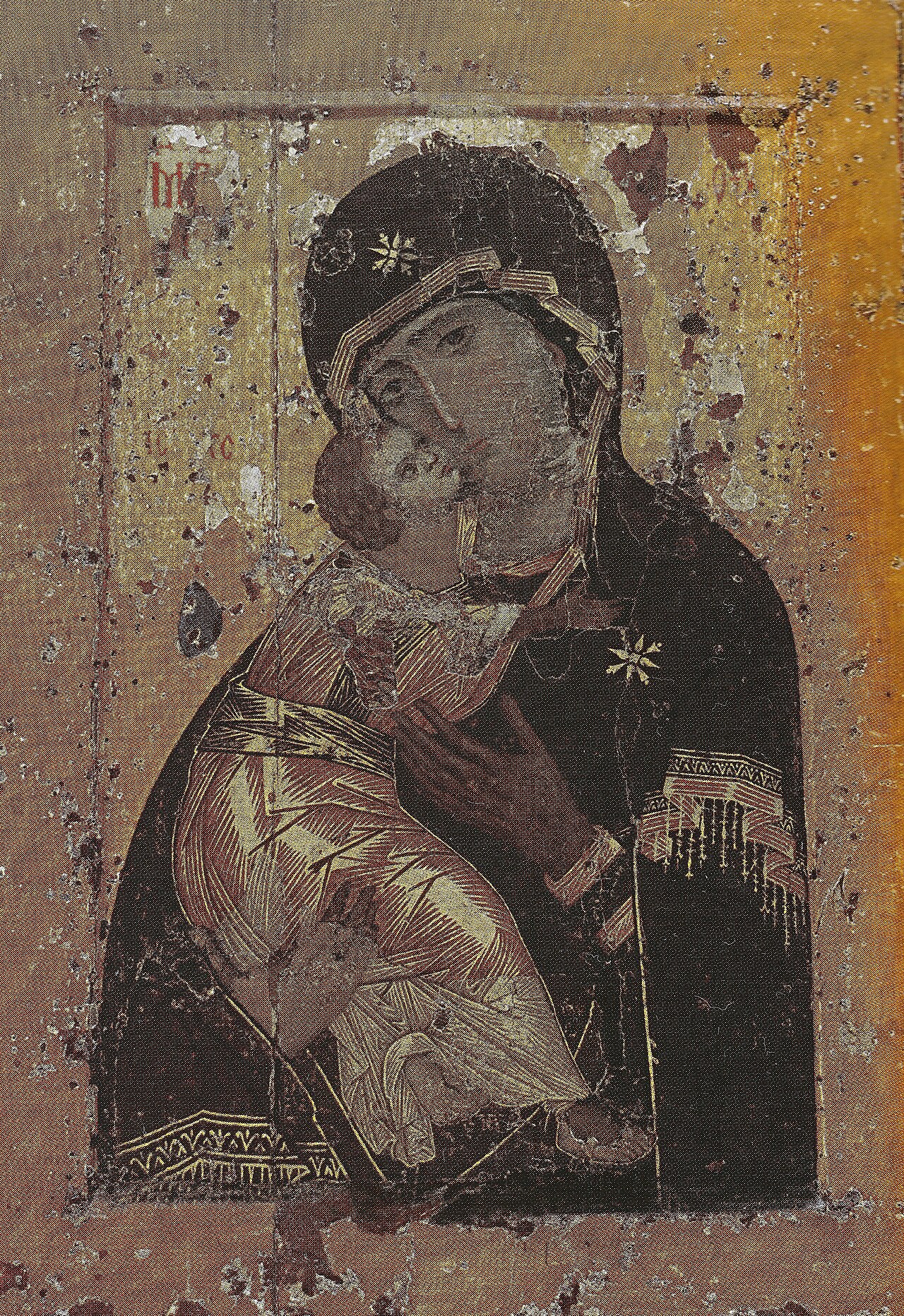
Every authentic Marian title says something first about who Christ is and then about what redeemed humanity may become in him.
She is honored above every saint as the Mother of God; adoration belongs to the uncreated Trinity alone.
Mary’s holiness is neither passive nor autonomous: grace calls, human freedom answers, and the Word takes flesh.
She receives the Word, bears Christ to the world, prays with the apostles, and anticipates the creature’s transfiguration.
The doctrinal center
Theotokos translates Greek Theotókos, literally “God-bearer” or “the one who gives birth to God.” It does not mean that Mary is the source of the Godhead or mother of the divine nature. It means that the person born from her according to his humanity is truly God the Word. The Council of Ephesus in 431 received St Cyril of Alexandria’s defense of the title because the alternative divided Christ: Mary bore neither a mere man nor a human partner alongside the Logos, but the one incarnate Son. 1
The Church therefore calls her Most Holy (Panagia), Ever-Virgin (Aeiparthenos), full of grace, Mother of God, and our Lady. “Most Holy” names the fullness of her creaturely sanctification, never divinity. “Ever-Virgin” confesses her virginity before, in, and after Christ’s birth. “Our Lady” is relational honor: she is the mother of the Lord and first among the saints, not a fourth member of the Trinity.
Worship offered to God alone: Father, Son, and Holy Spirit.
Love, reverence, and invocation given to saints and sacred images in relation to God.
This distinction is visible in practice. Orthodox Christians bow before and kiss her icon, sing her praises, and ask her prayers; they do not offer her the Eucharistic sacrifice or name her as the source of grace. The honor passes through the icon to the person depicted, and the saint’s glory is God’s work in a human life. 2
Mary is also called the New Eve and the image of the Church. She is not an exception who makes ordinary Christian life irrelevant; she is the most radiant disclosure of its goal. In her, divine initiative and undestroyed human freedom meet. She hears, questions without unbelief, consents, bears Christ, keeps his words, suffers beside him, and remains in the praying communion of his disciples.
Canonical witness
The Orthodox reading is both literal and ecclesial. It begins with what each text says in its own narrative, then hears the passage inside the whole canon and the Church’s worship.
Matthew 1–2
Luke 1–2
John 2; 19:25–27
Acts 1:14
Revelation 12
The Old Testament received in Christ
The richest Orthodox “commentary” on Mary is often sung. The Church appoints Jacob’s ladder, Ezekiel’s east gate, and the house of Wisdom at her major feasts, then extends this grammar across Scripture in canons, stichera, homilies, and icons. 3
Genesis 3 · Luke 1
Eve’s distrust is answered by Mary’s obedient faith. The comparison is already explicit in St Irenaeus: the knot of disobedience is loosed by obedience.
Exodus 40 · 2 Samuel 6 · Luke 1
The glory overshadows the tabernacle; the Spirit overshadows Mary. Luke’s Visitation echoes David before the ark: journey to the hill country, awed greeting, leaping, and a three-month stay.
Exodus 3
The bush receives fire and is not consumed: a figure of the Virgin receiving the divine Word without the destruction of her creaturely integrity.
Genesis 28:10–17
In her, heaven and earth meet because the Word truly takes flesh. The passage is appointed at Vespers for major feasts of the Theotokos.
Ezekiel 43:27–44:4
The closed gate filled by the Lord’s glory becomes a liturgical image of her unique, ever-virgin motherhood.
Proverbs 9:1–11
Christ is the Wisdom of God; Mary is the living house prepared for his embodiment. The reading is analogical and Christ-centered.
Judges 6:36–40
Gideon’s fleece images grace descending silently and the mystery of a conception beyond ordinary generation.
Numbers 17 · Isaiah 11:1
Life flowers where nature appears barren: a sign of the Virgin birth and of Christ, the shoot from Jesse.
Song of Songs 4:12
The bridal poem is received as a figure of purity and ever-virginity; it belongs to the Church’s poetic exegesis, not the passage’s plain historical sense.
“The knot of Eve’s disobedience was loosed by the obedience of Mary.”
St Irenaeus of Lyons · Against Heresies 3.22.4 4
Three controls keep typology sound. First, Christ is the center: the Ark matters because it bears the divine presence; Mary matters because she bears Christ. Second, type is not identity: she is not literally wood, temple stone, or Wisdom’s divine person. Third, liturgy tests the reading: stable images recur in the common services of the Church rather than depending on private ingenuity.
From apostolic memory to living tradition
History does not show a single moment when “Marian devotion” was invented. It shows overlapping developments: biblical memory, Christological exegesis, ascetic ideals, prayers for intercession, local feast days, imperial patronage, sacred images, and increasingly elaborate hymnography. The evidence is uneven, and later devotional memory is not the same kind of source as a dated papyrus or council act.
The Protoevangelium of James, probably from the late second century, is decisive for later traditions about Joachim and Anna, Mary’s childhood, and her Entrance into the Temple. It is not canonical Scripture; nevertheless, its narratives entered the Church’s liturgical memory and iconography. 5 An Egyptian fragment of “Beneath your compassion” gives early material evidence of Christians addressing the Theotokos for protection, although scholarly dating ranges widely. 6
Paul names Christ as “born of a woman”; Matthew and Luke confess the virginal conception; John places Mary at Cana and the Cross; Acts remembers her praying with the apostolic community.
The Protoevangelium of James supplies names and narratives later received in the feasts of her Nativity and Entrance. Irenaeus articulates Mary as the obedient New Eve.
The Egyptian Sub tuum praesidium papyrus invokes the Theotokos for protection. Its date is disputed, but it witnesses an already formed prayer rather than a first experiment.
The council receives Cyril’s Christology: the one born from Mary according to the flesh is the eternal Word himself. Popular Marian devotion and doctrinal controversy now meet in a public conciliar settlement.
Nativity, Annunciation, Entrance, and Dormition take liturgical shape in different places and at different speeds. Constantinople grows under her patronage; the Akathist becomes a summit of biblical and conciliar poetry.
Iconoclasm attacks sacred images; Nicaea II (787) teaches that honor shown to an image passes to its prototype. The restoration of icons in 843 secures the visual grammar of Orthodox devotion.
Theotokia permeate the offices; icon types and feast cycles travel through the Slavic, Georgian, Romanian, Arabic, and other Orthodox worlds. Local icons become centers of pilgrimage and communal memory.
Akathists, Paraklesis, the Protection feast, wonder-working icons, and prayer rules continue to develop without replacing the common liturgical core. St Seraphim’s Marian life belongs to this received tradition.
Ephesus is therefore both a watershed and not a beginning. It gave universal doctrinal force to the title Theotokos, while fifth- through seventh-century preachers and hymnographers elaborated what the title meant for salvation, intercession, virginity, city, empire, and the Church. 7 The Dormition traditions likewise emerge in several forms before reaching mature liturgical synthesis; historical diversity should be acknowledged even while the feast is prayed as one ecclesial confession. 8
Doctrine embodied in time
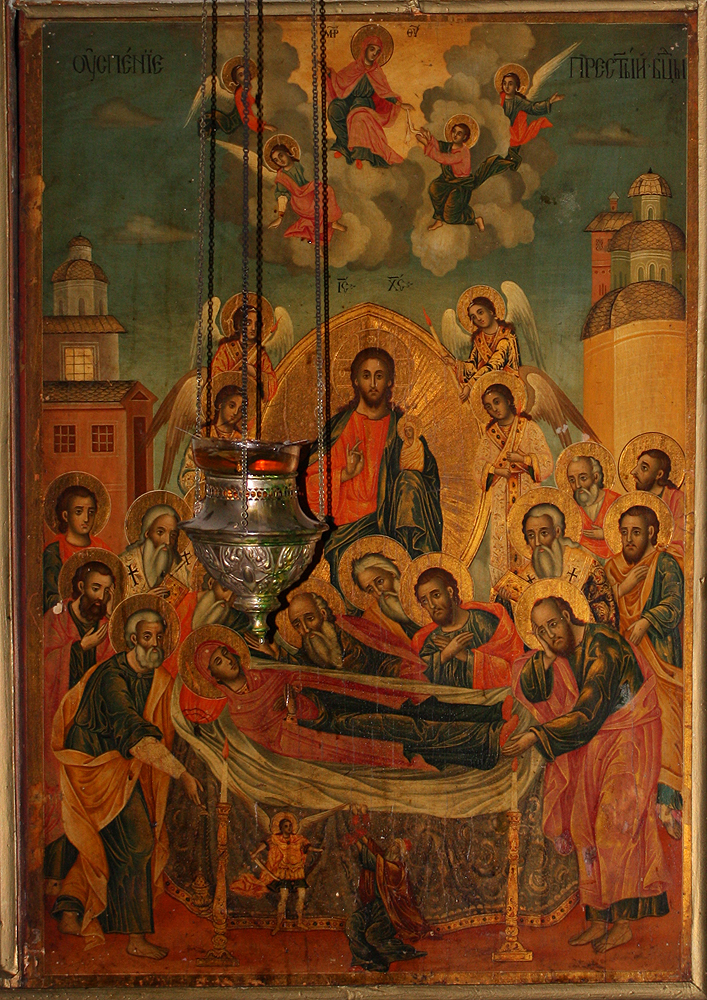
The liturgical year opens with her Nativity on September 8 and closes with her Dormition on August 15. Entrance (November 21) and Annunciation (March 25) complete the four Marian feasts among the Twelve Great Feasts. The Dormition is preceded by a two-week fast; Protection and numerous local icons carry regional prominence.
Hymns to the Theotokos are woven through Vespers, Matins, the Hours, and other offices—often at the close of a sequence, where they gather the preceding theology into the mystery of the Incarnation.
After the Eucharistic consecration, the Church commemorates her “especially,” then all the saints. The placement is theological: the Eucharistic Christ truly received human nature from her, and the redeemed communion is already visible in her.
Veneration is tactile. The faithful stand before her icon, cross themselves, bow, kiss the image, light candles, carry icons in procession, and sing. Matter participates because the Word truly became flesh.
The Small and Great Supplicatory Canons are prayed in illness, danger, grief, and especially during the Dormition Fast. The request is not that Mary replace Christ, but that the foremost member of his Body pray with and for its suffering members.
The twenty-four stanzas of the Akathist move alphabetically through Annunciation, Nativity, salvation, and the new creation. Chanted standing, it is among Byzantium’s highest unions of dogma and poetry. 10
Theology seen
An icon is not merely a portrait or religious illustration. It bears a name, belongs to a received visual grammar, and presents the person in the transfigured communion of Christ. Marian icons are Christological even when Christ is not visibly present. 9
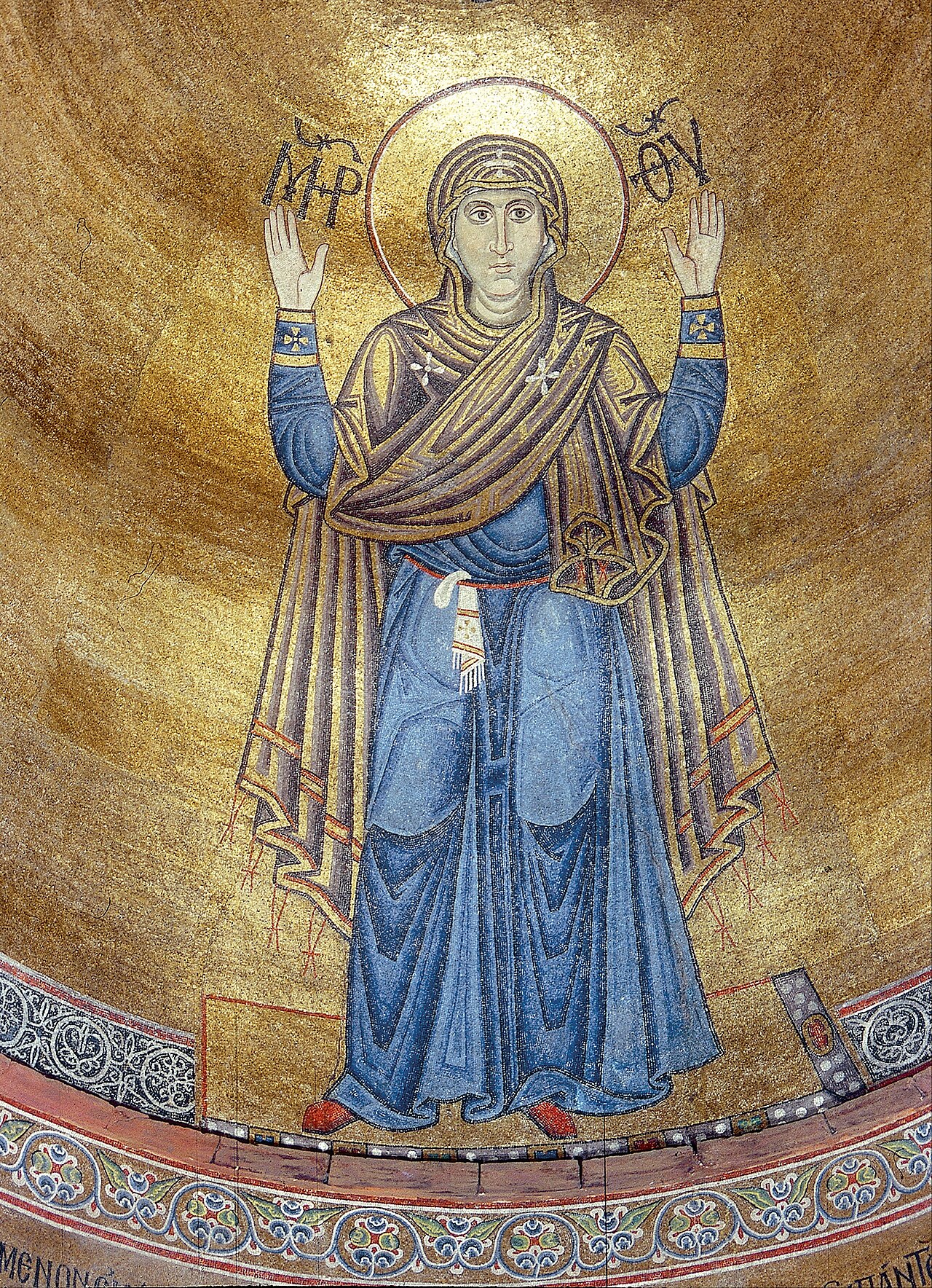
Abbreviation of Mētēr Theou: “Mother of God.” The inscription identifies the person; it is not decoration.
Usually placed on forehead and shoulders, confessing virginity before, during, and after the birth of Christ.
The dark red-purple outer veil signifies her historical womanhood, royal dignity, and life gathered into divine grace.
Pointing shows the Way; raised hands intercede; embrace reveals tenderness and often foretells the Passion.
Mary holds Christ and points toward him. Her gesture is the icon’s thesis: the honor given to her directs the beholder to the Savior.
Mother and Child touch cheeks. The intimacy is real, but Mary’s grave gaze often anticipates the Passion. The Vladimir icon is the great exemplar.
Mary stands in prayer, often with Christ Emmanuel in a medallion at her breast. In the apse she becomes “more spacious than the heavens”: the created person who contained the Uncontainable.
Mary is seated as a living throne while Christ blesses from her lap. Majesty belongs to the incarnate King; her throne-like role proclaims the reality of his flesh.
Mary appears without the Child, turned in prayer toward Christ. The type makes her intercessory posture visible.
Annunciation, Nativity, Presentation, Cana, Crucifixion, Ascension, Pentecost, and Dormition place her within salvation history. She never has a story independent of Christ and his Body.
Theology on the lips
Orthodox prayer often says, “Most holy Theotokos, save us.” Here save carries its ordinary biblical range—rescue, preserve, help—not “be the divine Savior.” Christians can say that a preacher, physician, neighbor, or apostle saves someone instrumentally (compare 1 Corinthians 9:22; 1 Timothy 4:16) while confessing that salvation in its source and fullness belongs to God. The prayer asks Mary’s powerful intercession within Christ’s one saving work.
Rejoice, O Virgin Theotokos, Mary full of grace, the Lord is with thee. Blessed art thou among women, and blessed is the fruit of thy womb, for thou hast borne the Savior of our souls.
Luke 1:28, 42 received as the Church’s daily greetingIt is truly meet to bless thee, O Theotokos, ever-blessed and most pure, and the Mother of our God; more honorable than the Cherubim and more glorious beyond compare than the Seraphim…
Sung in the Divine Liturgy and in personal prayerBeneath thy compassion we take refuge, O Theotokos. Do not despise our supplications in necessity, but deliver us from dangers, O only pure, only blessed one.
Sub tuum praesidium · wording varies by traditionA whole theology in six words: the human mother of the incarnate Lord, alive in him, is asked to hasten with her prayers to those in danger.
Common in canons, litanies, and personal prayerA prayer rule is received, not self-optimized. Those entering Orthodox practice should use the translation and rhythm of their parish and seek a priest’s guidance before adding a long rule.
A saint beneath her protection
Marian devotion does not sit at the edge of St Seraphim’s life; it forms its narrative spine. His Life remembers childhood healing during a procession of the Kursk Root Icon of the Sign, repeated visions of the Mother of God, and a command from her that ended his strict reclusion and opened his eldership to the world. At Diveyevo he regarded her as the monastery’s true abbess. He died kneeling before his Umilenie (“Tenderness”) icon, which he called “Joy of All Joys.” 11
The Rule of the Theotokos associated with Seraphim’s circle repeats the Angelic Salutation 150 times. Its later fifteen-mystery form, arranged by Hieromartyr Seraphim Zvezdinsky, moves from Mary’s Nativity to her glorification. It belongs here as a bridge: biblical words becoming contemplative memory, and contemplation returning the soul to Christ.
Further study and reflection
Read in two columns at once: the Church’s own worship and the historian’s account of how that worship took shape. Neither cancels the other; each answers a different question.
Consequential historical and theological claims are tied to primary, official, or scholarly sources. The notes distinguish conciliar confession, liturgical tradition, hagiography, and modern historical reconstruction.
Primary and official Orthodox sources appear first in the argument; modern scholarship is used especially where dates, development, and documentary evidence are contested. Image records are included for provenance.