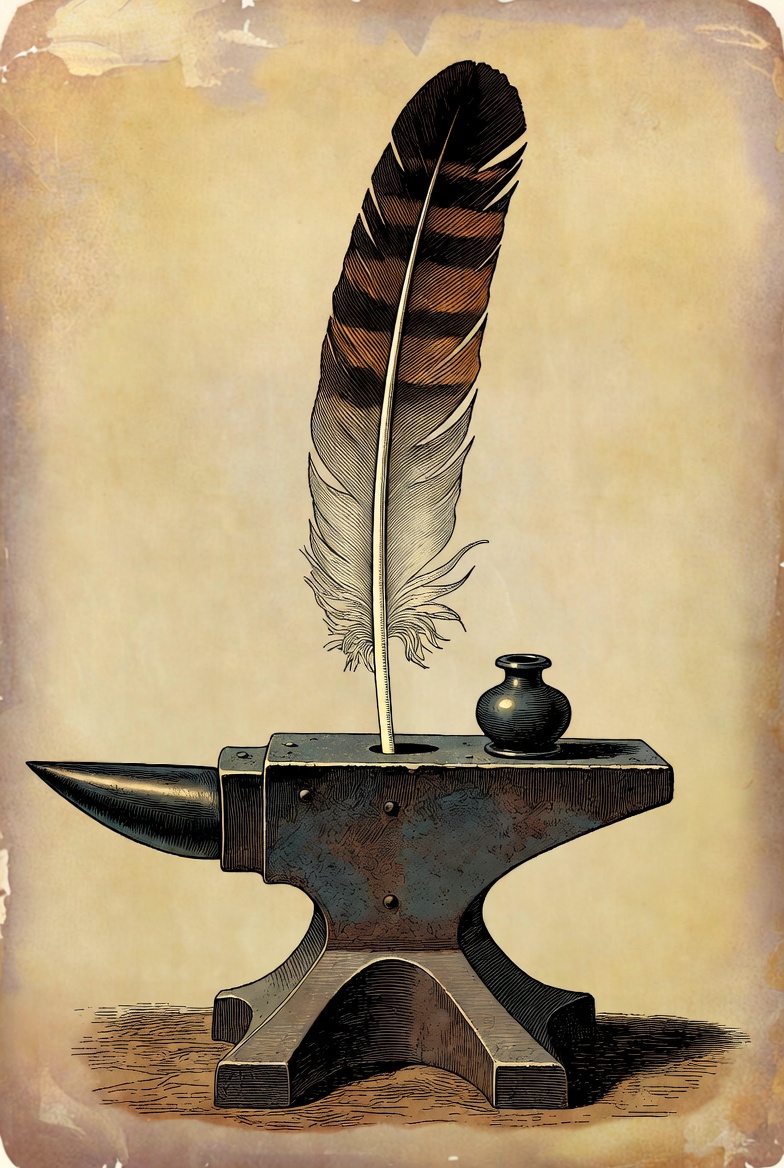
"A neglected poetical genius… held in high repute by his countrymen."
The Bard of the West
There is a temptation, tracing a name backward, to look only for kings and castles — the gallowglass lords, the stronghold on Sheephaven Bay, the clan that commissioned its own book. But a name carries more than lordship. It can carry an office. And in the poor townlands of nineteenth-century Connemara, the name Mac Suibhne belonged to a man who practised the oldest office the Gaelic world knew: the maker of songs a whole district kept by heart.
His name was Mícheál Mac Suibhne, and the English-speakers of Iar-Chonnacht called him, simply, the Bard of the West.
A Life at the Edge
He was born around 1760 at Funshinaugh, near the ruined abbey of Cong — then part of County Galway, now within County Mayo. The names of his parents are not recorded. His family, tradition holds, had come west from Ulster generations before, refugees of the Cromwellian settlement — one more branch of the scattered Sweeney name carried far from the Donegal coast where the clan had held its castles.
He and his brother Toirdhealbhach moved to Tooreen, in the parish of Ballinakill between Letterfrack and Clifden, where Mícheál worked as a blacksmith for a landlord named Steward. A poet at the forge: the image is almost too apt for a man of the Sweeney name, whose arms carry the axe and whose ancestors were smiths of war. But his making was in words. He composed everything in Connacht Irish, his native tongue — poems and sean-nós songs meant to be sung, not read — and he became most associated with the town of Cleggan, on the far Atlantic edge of Connemara.
He was, by every account, poor, and by many accounts a heavy drinker. He is believed to have died around 1820 at Fahy, near Clifden. His burial place is unknown. Whether he ever married is not known either. The Bard of the West left no monument but his songs — which is to say, he left the only monument a bard was ever meant to leave.
The Songs
Mac Suibhne's work survived first the way all bardic work survived: in memory, sung from one person to the next, so that — as Hardiman observed in 1846 — there were few in the district who could not repeat some of them. The written record came later, and in two stages.
James Hardiman, editing Roderic O'Flaherty's Iar or West Connacht (1846), was the first to print him. In the Additional Notes he set down full versions of three pieces:
- Banais Pheigi Ní Eaghra — "The Connemara Wedding," reckoned his most popular work, an exaggerated account of the preparations for a lavish wedding. As the Dictionary of Irish Biography records, it is said to have arisen from a witty exchange in which the poet listed extravagant demands in order to avoid an unwanted match.
- Abhrán an Phúca — the "Song of the Púca," a wry, sceptical turn on local folklore.
- Eóghan Cóir — a satirical piece on a land agent, of a kind common in the period.
It was Hardiman who gave him, in print, the title the English-speakers already used: the Bard of the West, a composer of songs that afforded, in Hardiman's phrase, real social pleasure to the people of Iar-Chonnacht.
Tomás Ó Máille, after the War of Independence, gave him his scholarly monument: Mícheál Mac Suibhne agus Filidh an tSléibhe (Dublin, Oifig an tSoláthair, 1934) — "Mícheál Mac Suibhne and the Poets of the Mountain" — the definitive edition of his surviving corpus, gathered alongside the work of other Connemara "mountain poets." It remains the primary source for everything that can be said about him.
From these collections the shape of his range emerges:
- Máirín Seoighe — a love-song in praise of a woman of that name, set in his native Cong district and thought to be among his earliest works.
- Jenny Ward and a version of Muirnín na Gruaige Báine — further romantic compositions. (The DIB notes that the latter is implausibly said to have been made for a daughter of Richard Martin, the MP and reputedly the largest landowner in Ireland — a reminder of how folk attribution gathers around a well-loved name.)
- An Turcach Mór — "The Big Turk," occasioned, in Ó Máille's account, by a carved ship's figurehead washed ashore on the Connemara coast.
- The Errislannan satire (Iorras Fhlannáin) — a curse-poem against the people of Errislannan for their want of hospitality: the classic bardic reprisal, the poet turning his one weapon on a household that failed the old law of welcome.
Ó Máille set aspects of his praise-poetry beside that of his more famous contemporary Antoine Raiftearaí — the two of them wandering makers of the western Gaeltacht, working the same folk register of praise for people and places in a language the printed world was already leaving behind.
Why He Belongs Here
Mícheál Mac Suibhne is not a link in the Doe Castle pedigree. The Connemara Sweeneys were their own branch, and the Ulster origin his tradition claims is exactly that — a claim, of the kind this atlas has learned to hold lightly. He is here for a different reason, and a truer one.
He is proof that the name kept its oldest work. Long after the castles fell and the gallowglass trade ended, in a townland at the western edge of Ireland, a man called Mac Suibhne was still doing what the Leabhar Chlainne Suibhne had done in vellum and the ballad-makers had done in song: catching a life, a place, a grievance, a wedding, and giving it a form that would outlast him. The clan commissioned its book. The ballad tradition kept its dead. And the Bard of the West, at his forge in Ballinakill, made songs a whole country could sing from memory — which is the same office in a poorer coat.
The name has always carried the maker. He is one more who answered to it.
Sources
- Dictionary of Irish Biography, "Mac Suibhne, Micheál" (Vincent Morley)
- James Hardiman (ed.), Iar or West Connacht (1846), Additional Notes
- Tomás Ó Máille, Mícheál Mac Suibhne agus Filidh an tSléibhe (Dublin, 1934)
- Brian O'Rourke, "County Mayo in Gaelic Folksong," in Mayo: Aspects of its Heritage, ed. Bernard O'Hara (1982)