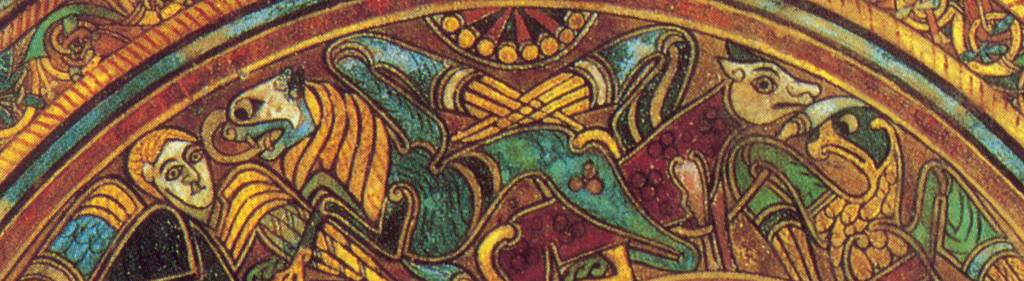
The Kept Book
In the library of the Royal Irish Academy in Dublin, under the shelfmark MS 24 P 25, sits a vellum book about fourteen inches tall, some eighty folios of it surviving, written over the course of the sixteenth century for one family: the MacSweeneys of Fanad. Its name is the Leabhar Chlainne Suibhne — the Book of Clan Sweeney — and it is the single most important thing the family ever made that was not a castle.
It is not a chronicle, exactly, and not a prayer book, exactly, and not a poem-book, exactly, because it is deliberately all three at once. The volume binds together a book of piety commissioned by a chief’s wife, a historical tract tracing the clan from Argyll to Donegal, and a duanaire — an anthology of bardic poems in praise of three generations of Fanad chiefs. Devotion, history, poetry: a household’s whole interior life, written down and held.
Most of what this site’s Ancestry pages can responsibly say about the family’s medieval self-understanding descends from this one object. The Gallowglass page tells the story of the axe; this page attends to the book — what is in it, who caused it to be written, how it survived, and where to see it.
The Manuscript at a Glance
Three Books in One Binding
The Leabhar is a composite: three distinct campaigns of writing, decades apart, gathered into a single volume because the family understood them to belong together. Read in order, the three sections are a portrait of what a Gaelic lordly house thought worth keeping.
Folios 1–65 · 1513–14
The Book of Piety
Lives of Patrick, Colm Cille, Margaret, and Catherine; the Finding of the True Cross; the Harrowing of Hell and the Gospel of Nicodemus; teaching on confession, the Mass, and St Patrick’s Purgatory. A late-medieval noblewoman’s devotional library, written in Irish from the common European stock of piety — made on Tory Island by the scribe Ciothruadh Mág Fhionngoill.
Folios 66–72 · 1532–44
The Clan History
Craobhsgaoileadh Chlainne Suibhne — “the Branching-Out of Clan Sweeney” — written by Tadhg mac Fithil: the family’s origin, the crossing from Scotland, and the planting of the Donegal lordships of Fanad, Doe, and Banagh. The primary medieval source for the clan’s understanding of itself, published with facing translation by Paul Walsh in 1920.
Folios 73–81 · 16th–17th c.
The Duanaire
Some two dozen bardic poems in various hands for three chiefs of Fanad: an elegy on Ruaidhrí Mac Suibhne (d. 1518), poems for Toirrdhealbhach (d. 1570), and poems for Domhnall, still living in 1619. The family’s deeds held in the strict meters of the professional poets the family patronized.
The order matters less than the fact of the binding. Other Gaelic houses kept poem-books; some kept genealogies; devotional manuscripts survive in numbers. What is rare is one volume that holds all three — the praying house, the remembering house, and the sung house between two covers. Whoever assembled the Leabhar was making an argument about what a family is.
The Woman Who Commissioned It
The oldest and largest part of the book exists because a woman ordered it. Máire Ní Mháille — a daughter of the seafaring O’Malleys of Mayo, married north into Fanad as wife of Ruaidhrí Mac Suibhne — commissioned the Book of Piety, and the scribe who wrote it for her, Ciothruadh Mág Fhionngoill, worked on Tory Island, the bare Atlantic rock off the Donegal coast that had been a place of monks since Colm Cille’s day.
Hold the picture a moment: the wife of a gallowglass lord — a house whose trade was the axe — spending her wealth not on plate or cloth but on a book of saints’ lives in her own language, written on an island of hermits, for the use of her household. When Ruaidhrí died in 1518, the poets’ elegy for him went into the back of the same volume. Her book became the family’s book; the family’s book became its history’s home.
Máire’s commission is also the reason the Leabhar can be dated and placed at all — the scribe recorded for whom and when he wrote. The book remembers its patroness by name, five centuries on. That, too, is what books are for.
Why the Book Matters
It would be easy to file the Leabhar as clan memorabilia — a curiosity for genealogists. It is more than that. Consider what it establishes:
- The family kept a scriptorium’s company. The professional soldiers of Fanad commissioned scribes, patronized poets, and endowed religious houses. The book is the surviving proof that the gallowglass lordships were houses of letters as well as of axes — the fact that undoes the caricature of the hired brute.
- The keeping was deliberate. Sections written thirty years apart were joined on purpose. Successive generations added poems for successive chiefs. The Leabhar was a living book, added to across a century, carried through the collapse of the world that made it, until it came to rest in the Academy.
- The instinct has a shape. Piety, history, poetry: formation of the soul, account of the line, and the music that carries both. A house that keeps such a book is saying — without ever saying it — that these three belong together, and that a family which loses any one of them has lost part of its name.
Elsewhere on this site I call the family’s oldest instinct the instinct to have the story written down and held — from Moling taking the mad king’s poems at dictation, to the Four Masters recording Donegal’s ruin as it happened. The Leabhar is that instinct in its purest surviving form: not a story about the family keeping its book, but the kept book itself, still on the shelf, still readable. This website is, knowingly, the same kind of object in a newer medium — and it is under no illusion of being the first of its line.
What the Book Claims
The Manuscript Today
The Leabhar survived the fall of the lordships, the confiscations, and the long scattering of the name, and passed eventually into the collections of the Royal Irish Academy on Dawson Street, Dublin, where it remains — MS 24 P 25, Catalogue No. 475. It sits in the same library as the fullest manuscript of Buile Suibhne: the two Sweeney books, the clan’s and the king’s, kept under one roof by the same institution.
You do not need to travel to Dublin to see it. The manuscript has been photographed in full by Irish Script on Screen (ISOS), the Dublin Institute for Advanced Studies project that digitizes Ireland’s manuscript heritage — every opening of the vellum viewable at high resolution.
Digital facsimile
Irish Script on Screen ↗
Full digital images of RIA MS 24 P 25 — the vellum itself, opening by opening.
The keeper
Royal Irish Academy Library ↗
The Academy’s library holds the manuscript among the greatest collection of Irish-language manuscripts in the world.
Reading It — Walsh’s Edition
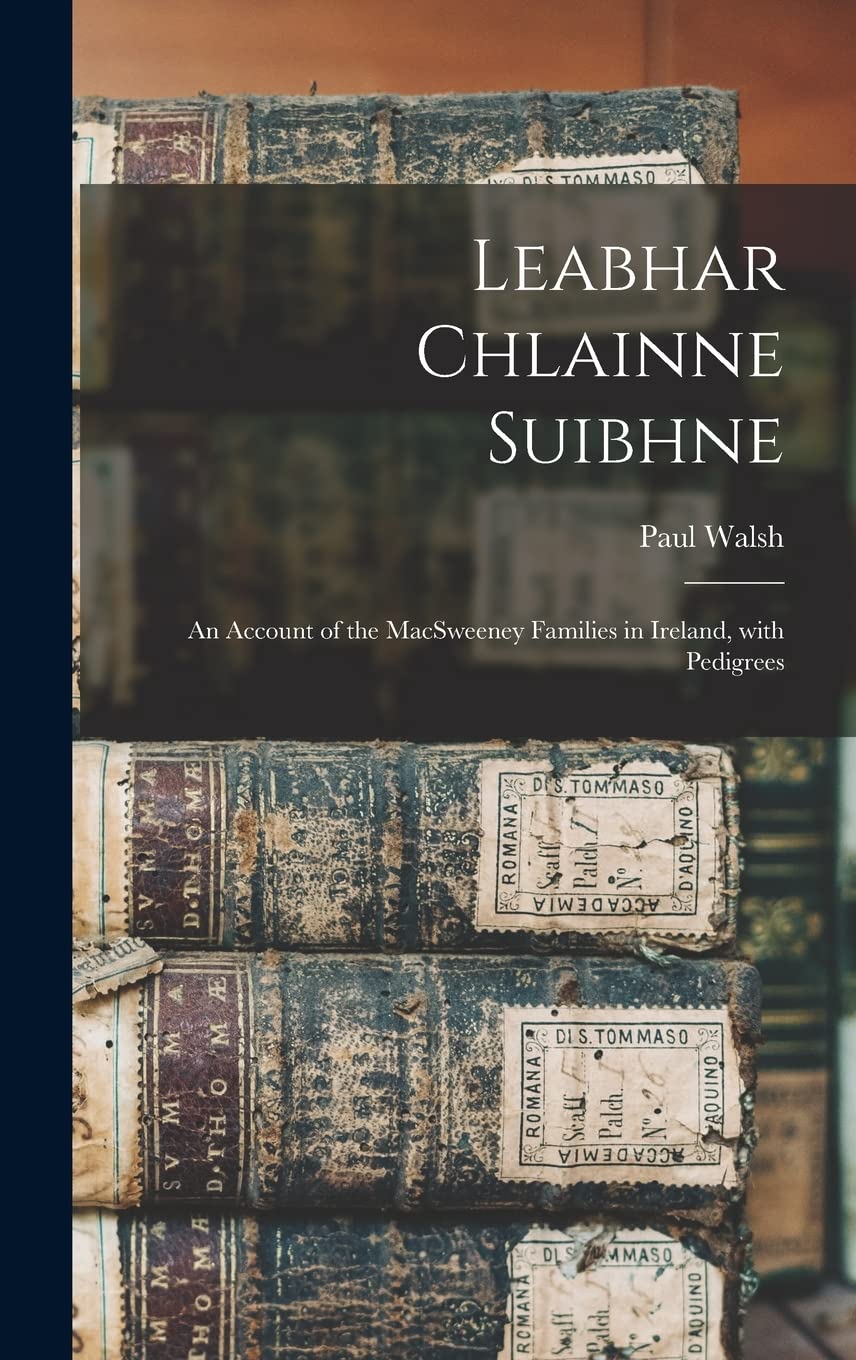
Essential · Free
Paul Walsh, 1920
Fr. Paul Walsh edited the historical tract and pedigrees as Leabhar Chlainne Suibhne: An Account of the MacSweeney Families in Ireland, with Pedigrees — Irish text and English translation on facing pages, with an introduction that remains the best single doorway into the manuscript. The edition is long out of copyright: read it free at the Internet Archive, or find it in modern print-on-demand reprints. Read the introduction first; it is short, and it hands you the whole book.
Explore Further
- The Reader’s Aids — the working marks made for manuscript readers →
- The Bard’s Dilemma — the bardic office this book exemplifies →
- Mícheál Mac Suibhne — the Bard of the West →
- The Gallowglass — the trade and the dynasty →
- MacSweeney Clan Atlas →
- Buile Suibhne — The Source →
- Buile Suibhne — The Study →
- Doe Castle — Mac Suibhne na dTuath →
- The Ballad of Turlough Óg — song as kept memory →
- Take Flight — the practice of keeping →
Sources & Further Reading
Paul Walsh, Leabhar Chlainne Suibhne (Dublin, 1920) — Internet Archive
Irish Script on Screen: RIA MS 24 P 25 — full digital images
Royal Irish Academy Library — holder of the manuscript (MS 24 P 25, Cat. No. 475)
- Pádraig Ó Macháin, “The Duanaire of Domhnall Mac Suibhne,” Celtica 27 (2013)