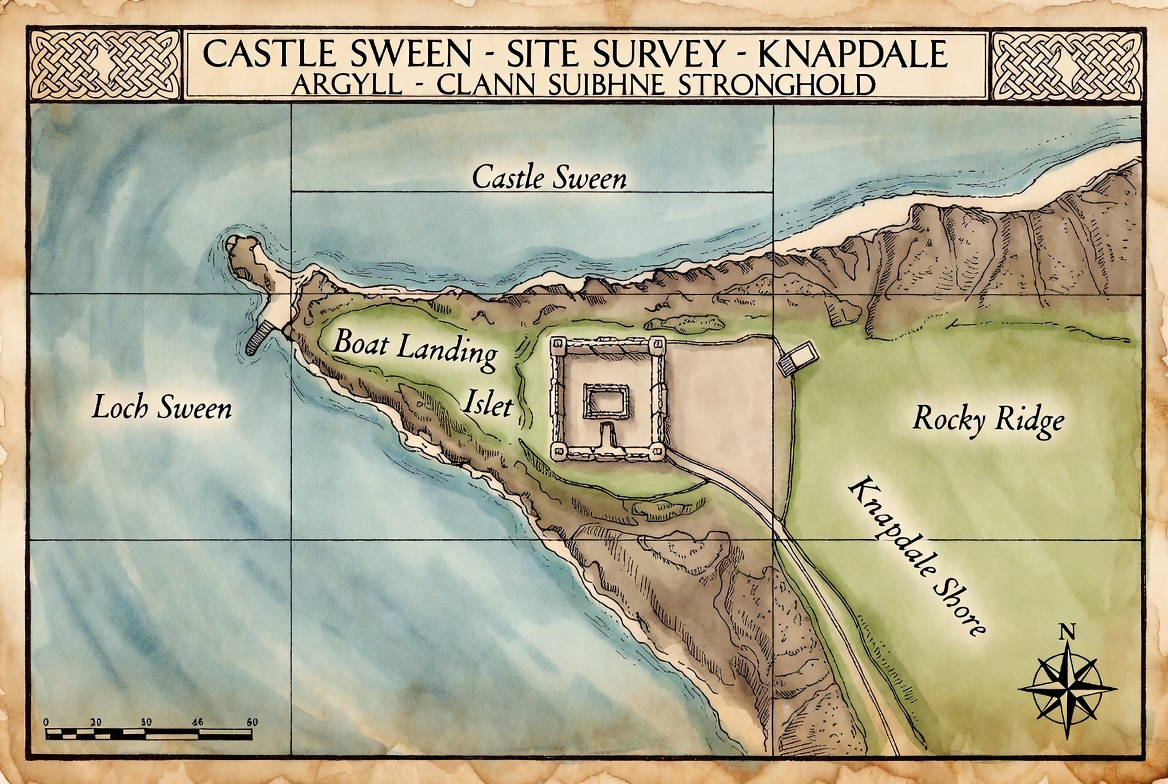
“A tryst of a fleet against Caisteal Suibhne.”
On the Loch
Castle Sween (Caisteal Suibhne — “Suibhne’s Castle”) stands on a low rocky ridge above a sea-loch in Knapdale, on the west coast of Argyll, looking out toward Jura. A massive, window-less curtain of stone raised nine centuries ago by the man from whom the whole name descends. Before there was a Doe Castle in Donegal, before there were gallowglass captains or a clan book, there was Suibhne the Red and the castle that still bears his name.
Castle Sween is the older twin of Doe Castle. Doe is the Irish stronghold of the professional warriors the name became famous for. Castle Sween is the Scottish house those warriors came from — the origin of the seafaring, axe-bearing identity that later crossed the water and made the name.
Timeline Snapshot
c. 1100–1150
Castle raised — Norman-style buttresses and near-absence of early windows point to the first half of the twelfth century.
c. 1262–1266
MacSweens displaced by the Stewart Earls of Menteith; Treaty of Perth settles the wider contest for the Isles.
c. 1310
John MacSween’s failed fleet against Caisteal Suibhne — remembered in the Book of the Dean of Lismore.
1647
Slighted by Alasdair MacColla’s Irish Confederate forces; never rebuilt as a living residence.
Key Moments
Historic Environment Scotland regards Castle Sween as the oldest standing castle on the Scottish mainland that can be dated with confidence — and it is often simply called the oldest stone castle in Scotland. These are the episodes that define its story.
Eponym
Suibhne the Red
The castle and loch take their name from Suibhne Ruadh — a Norse-Gaelic lord of the Anrothan line, remembered in the genealogies as descending through Aodh Álainn toward the Cenél nEógain of Ulster.
Loss
The losing of Knapdale
Not one blow, but the long squeeze of larger powers. By c. 1262 the MacSweens were displaced; after Bannockburn the Scottish heartland was gone for good.
c. 1310
A fleet against Caisteal Suibhne
John MacSween, backed by Edward II, came by sea to retake the ancestral seat. The expedition failed — and entered Gaelic memory as a mustering of a fleet against the castle.
Crossing
From castle to gallowglass
Landless in Scotland, branches of Clann Suibhne crossed the North Channel and became the most famous of the gallóglaigh. Gallowglass page →
Suibhne the Red
This is the fact the whole heritage section turns on. The name did not begin in Ireland and sail to Scotland. It began — as a family name — here, in Argyll, with this man and this castle, and only later returned to Ireland in the person of his warrior descendants. From Suibhne the Red the kindred took its name: Clann Suibhne — MacSween in Scotland, Mac Suibhne and MacSweeney in Ireland.
Architecture and the Sea
It was never a high royal keep. It was the base of a maritime lordship, and everything about it speaks of the sea. In the twelfth century the west-coast sea-lochs were the highways, and power moved by galley — the shallow-draft birlinns that could be run straight up onto a beach.
The Shore
Sited for a beach and galleys — a cleared islet nearby served as a boat landing; a postern in the west wall opened directly onto the shore.
Curtain Wall
A single massive quadrangular curtain — roughly two metres thick, eight metres high — enclosing a courtyard of timber buildings.
Lordship
From this one strong point Suibhne and his heirs held a territory that at its height reached from Loch Awe in the north to Loch Fyne in the south.
After the MacSweens
Late 1300s
Passed to the MacDonald Lords of the Isles; kept for them by MacNeills and then MacMillans — the MacMillan Tower still stands at the northwest corner.
1481
Crown, wary of MacDonald power, transferred the castle to the Campbell Earls of Argyll.
1647
Attacked and slighted by Alasdair MacColla’s Irish Confederate forces during the Wars of the Three Kingdoms.
Harp-peg
Among the excavated fragments is a harp-peg from the 1400s — a splinter of music left in the earth of the axe-bearing captains’ founding house.
A family that loses its house must become something that needs no house. This one did. The three great Donegal septs — Mac Suibhne Fánad, Mac Suibhne na dTuath (of Doe), and Mac Suibhne Bóghaineach (of Banagh) — grew from that crossing. They raised Doe Castle in the north and Rahan Castle in the southwest, and, in time, commissioned their own book of pedigree and poetry. So the losing of Castle Sween is not only an ending. It is the pressure that forged the name into the thing it is remembered as.
Visit Today
Grounds
Scheduled monument in the care of Historic Environment Scotland — free to visit, open year-round, unstaffed.
Approach
Car park near the Castle Sween Holiday Park, then a downhill walk of twenty to thirty minutes to the shore. Curtain walls still stand to a striking height; coastal erosion remains a threat on the seaward side.
The view across Loch Sween toward Jura is among the most atmospheric of any early Scottish castle — the same water, the same light, that Suibhne the Red looked out on when he chose the spot for its beach and its galleys.
Explore Further
- Doe Castle — the northern Irish house, Castle Sween’s younger twin →
- Rahan Castle — the southern Irish house, seat of Mac Suibhne Bóghaineach →
- The Gallowglass — Gallóglaigh →
- MacSweeney Clan Atlas →
- Leabhar Chlainne Suibhne →
- Mícheál Mac Suibhne — The Bard of the West →
Map & Landscape
Suibhne's Flight 637
- Dál nAraidhe Landscape
The east Ulster kingdom the tale gives Suibhne mac Colmáin. It is here he goes out naked to drive off Rónán Finn and throws the saint’s psalter into the lake — the offence the curse answers. The kingdom’s extent is approximate; the king lists know no Suibhne at that date. - Mag Rath · Mag Roth · Moira, Co. Down Battle
The Annals of Ulster record the battle under U637.1 — attestation, not story. In Buile Suibhne it is the hinge: three great shouts go up, the king’s fingers loosen on his weapons, his body grows light, and he rises out of the battle like a bird. Moira is a strong traditional association, not a settled site. - Glen Bolcain Landscape
The glen where Ireland’s madmen gathered, and the geilt’s one poor home — watercress, brooklime, and the great tree poems. The tale places it in the north; tradition looks to north Antrim. Marked here near Rasharkin as tradition suggests, not as fact. - Britain Landscape
Where Suibhne meets his mirror: Alladhán, a wild man of the Britons, cursed after his own battle. They keep each other’s misery a year and part when Alladhán goes to his foretold drowning. The tale says only "Britain"; scholars trace the geilt motif to the Brittonic north, so the marker sits on that coast. - Tech Moling · St Mullins, Co. Carlow Sanctuary
Moling’s monastery on the Barrow. The saint does not cure him and does not cage him — he receives him, lets him wander, and orders his story and his poems written down. Suibhne dies against the church door-post, reconciled. This site is that order obeyed once more.
The Crossing c. 1200 – 1314
- Castle Sween · Caisteal Suibhne, Knapdale Seat
The cradle. Suibhne of Argyll raised the oldest datable stone castle on the Scottish mainland here, and the clan took his name. Around 1310 John MacSween brought a fleet against his own ancestral castle to win it back, and failed — a raid remembered in the Book of the Dean of Lismore. After that there was no Scotland to return to. - Iona Sanctuary
Where the clan’s Scottish fathers were made and buried, before Kilmacrenan in Donegal took over the office. The family carried the shape of its inauguration across the water with everything else. - Fanad · Fánaid, Co. Donegal Landscape
The landfall. By about 1314 Murchadh Mear — Murchadh the Mad, the name’s shadow already showing — had planted the line in Fanad as professional soldiers. Exile becomes foundation: from him, the three lordships, the castles, the book, and every Sweeney since.
The Three Houses 1314 – 1600
- Rathmullan · Mac Suibhne Fánad Seat
The senior seat, on Lough Swilly. One hundred and twenty mailed gallowglasses owed to the O’Donnell; the priory endowed; Máire Ní Mháille’s commission of the family’s great manuscript. The last inaugurated lord of Fanad was still living in 1619. - Kilmacrenan Sanctuary
Where MacSweeney chiefs were inaugurated — the same ground on which the O’Donnells themselves were made. Hired swords do not get an inauguration site. Lords do. - Doe Castle · Caisleán na dTuath Seat
Sweeney Doe — Mac Suibhne na dTuath — on Sheephaven Bay: foster-fathers of Red Hugh O’Donnell, one hundred and twenty axes owed, the ornamented grave slab carved here in the high tide of the name. The last of them marched to Kinsale. - Dunfanaghy Landscape
The coastal landscape that frames Doe Castle’s story, and keeps its folklore. - Creeslough Landscape
The village at the head of the bay, grounding the castle in a place people still live. - Tory Island · Toraigh Sanctuary
An island of hermits off the Donegal coast, where the scribe Ciothruadh Mág Fhionngoill wrote the Leabhar Chlainne Suibhne for Máire Ní Mháille — a warrior household’s book of piety, in Irish. The family library begins here. - Rahan Castle · Mac Suibhne Bóghaineach Seat
Sweeney Banagh’s seat near Dunkineely, under Slieve League. Sixty axes owed — and one man to carry the mail shirt and the stone of Colum Cille. They bore the saint’s relic to war. - Slieve League · Sliabh Liag Landscape
The sea cliffs that wall the Banagh lordship, and mark the end of the Donegal coast the name held.
The Armada Year 1588
- Loughros Peninsula Wreck
La Duquesa Santa Ana driven ashore on the Loughros shore. Donegal commemoration remembers the survivors moving overland under the protection of "McSweeny na Doe" — a broader pattern in which MacSweeney authority is remembered as active, not merely passive, in the survivors’ story. - Doe Castle · Caisleán na dTuath Seat
Heritage Ireland’s own record for the castle states it plainly: the MacSweeney chief Eoghan Óg II gave shelter here to survivors of the 1588 fleet. Which ship’s men, how many, and what became of them, the record does not say. - Killybegs Harbour
The galleass La Girona anchored here damaged and crammed with survivors off other wrecks. MacSweeney Bannagh aided the Spanish and supported the repairs. She sailed for Scotland on 25 October. - Lacada Point · Port na Spaniagh, Co. Antrim Wreck
The night after leaving Killybegs, La Girona broke on the rocks below the Causeway headland. Of roughly thirteen hundred aboard, a handful reached shore. The repair at Killybegs bought them one day.
The Scattering 1598 – 1820
- The Yellow Ford Battle
O’Neill and O’Donnell’s great victory on the Blackwater — the old trade’s last full triumph, three hundred and forty years after the first Hebridean axes came to Ireland in a princess’s dowry. - Kinsale Battle
The chiefs of the name marched the length of Ireland in winter and shared in the defeat that ended the world that employed them. After Kinsale there is no Gaelic order left to need a hereditary axe. - Rathmullan · Mac Suibhne Fánad Seat
1607: from this shore the Earls sailed out of Ireland. The senior seat of the name watched the Gaelic world end from its own beach. - Cong Landscape
Mícheál Mac Suibhne was born at Funshinaugh near the ruined abbey of Cong — of a branch that tradition holds came west from Ulster generations before, refugees of the Cromwellian settlement. - Cleggan Landscape
The Atlantic edge of Connemara the Bard of the West is most associated with. A blacksmith at the forge in Irish-speaking Iar-Chonnacht, making songs a whole district kept by heart. The axe becomes the song. - Clifden Landscape
He is believed to have died at Fahy, near Clifden, around 1820. His burial place is unknown. The Bard of the West left no monument but his songs — the only monument a bard was ever meant to leave.
Further Reading
- Historic Environment Scotland: Castle Sween
- Book of the Dean of Lismore — Gaelic poem on the c. 1310 attempt on Caisteal Suibhne
- Clan MacSween / Anrothan genealogy — descent of Suibhne the Red from Aodh Álainn and the Ulster O’Neills